Essay · 4 October 2026 · 4 min read
A Junior Advocate's First Three Years Now Have a Price
A High Court has given a State Bar Council six months to set a minimum stipend. The money question hides a harder one about what those three years are actually made of.
A writ petition filed in 2005 came up for hearing at Jabalpur late last month. Twenty one years on the file. Somewhere in the course of it, the junior counsel appearing in the matter mentioned that she was not being paid anything for the work.
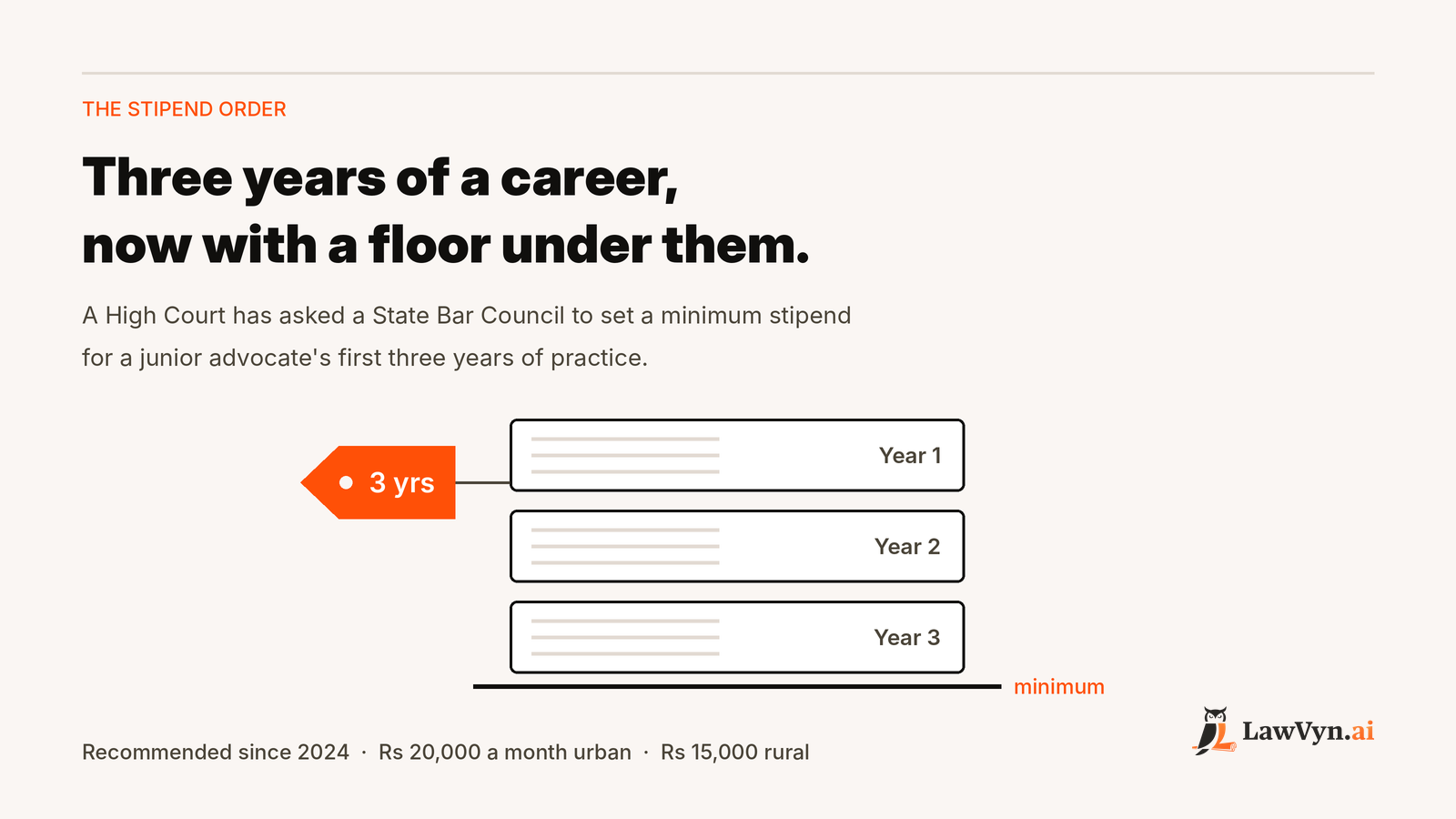
That one line is now an order of the Madhya Pradesh High Court. The court has directed the State Bar Council, in consultation with the bar associations, to lay down a guideline for a minimum stipend to be paid to junior advocates for their first three years of practice, and to do it within six months.
A recommendation becomes a floor
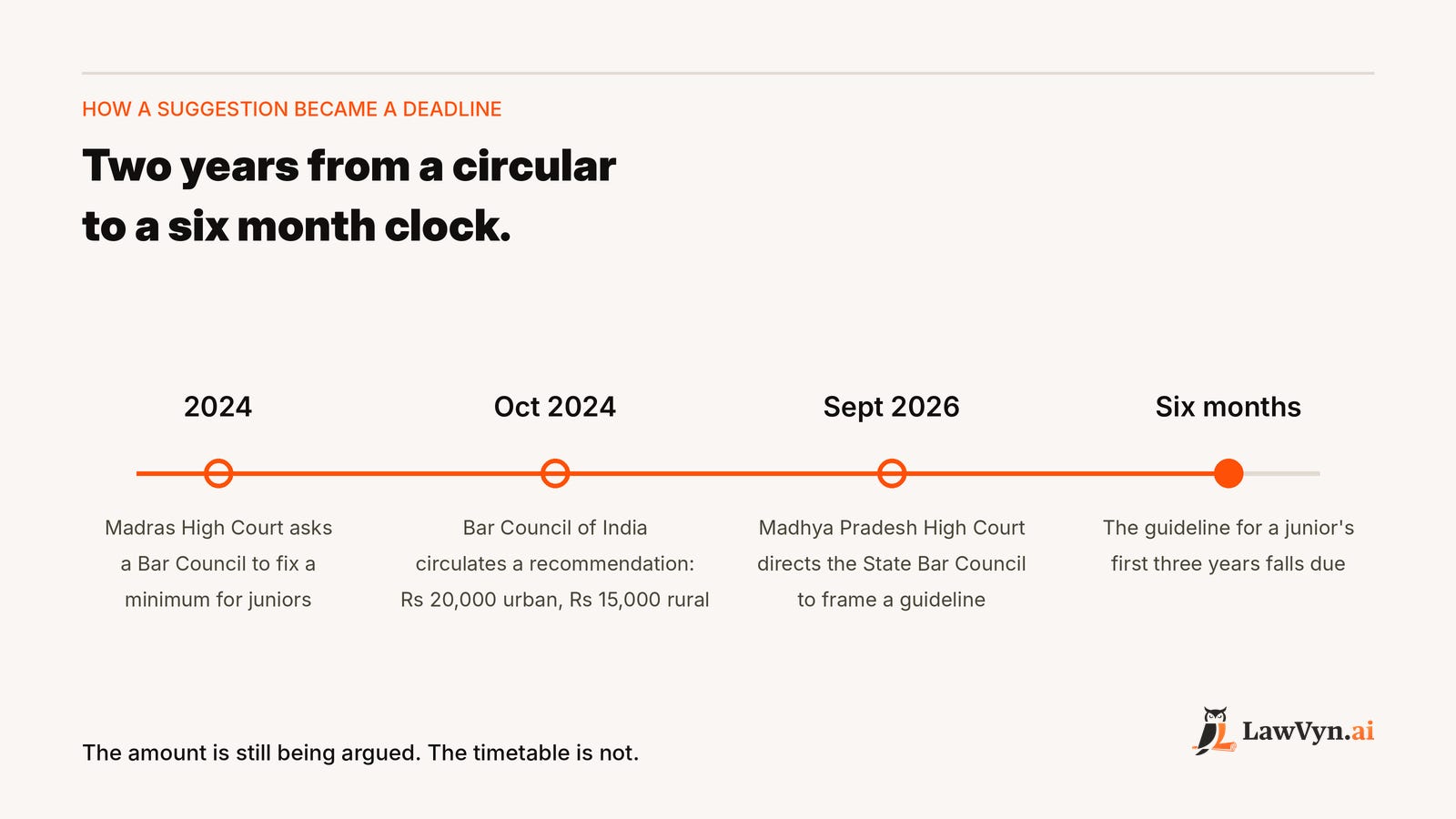
The number is not new. In October 2024, the Bar Council of India circulated a recommendation: twenty thousand rupees a month for a junior advocate in an urban area, fifteen thousand in a rural one. Recommendations travel slowly. Earlier the same year the Madras High Court had already asked a Bar Council to fix a minimum for juniors, and similar pleas have since reached other High Courts.
What changed in September is the shift from suggestion to timetable. Six months, one regulator, one state. The other State Bar Councils will almost certainly be asked the same question before long.
The number is the easy argument
Fifteen thousand or twenty. Urban or rural. Who checks. Whether a two-room chamber in a district court can carry it at all. All of that will be argued, and it should be.
The quieter question is the one the order drags into the room. What are those three years actually made of?
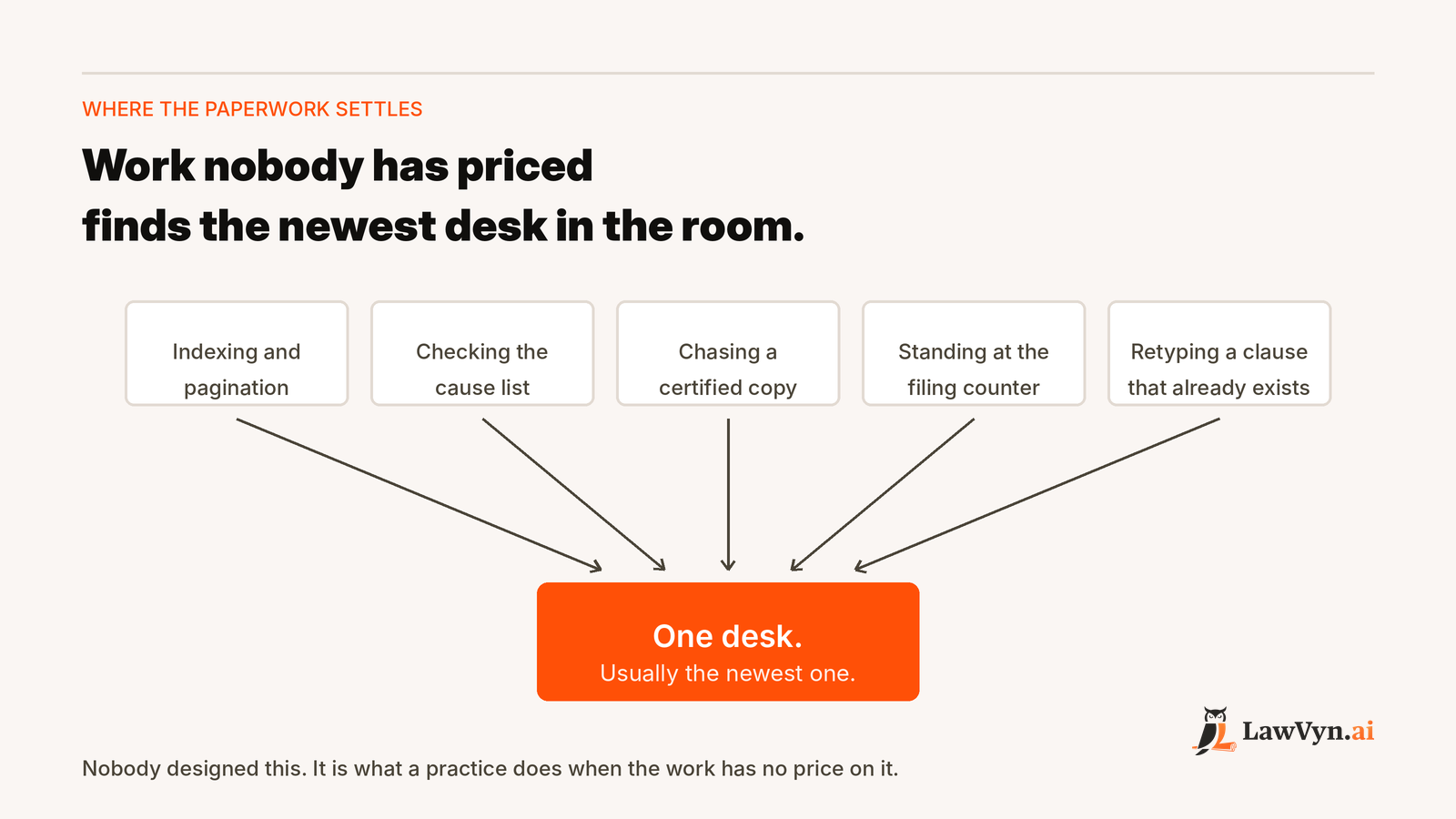
A great deal of a junior’s week goes into the mechanics of a practice rather than the practice of law. Indexing and pagination. Finding out whether the matter is listed, and before whom. Chasing a certified copy. Standing at a filing counter. Retyping a clause that already exists, almost word for word, in forty other files in the same chamber.
Nobody sat down and designed that. It is what happens when a profession grows faster than its machinery. The paperwork of a litigation practice has to be carried by someone, and in most chambers the only slack in the system is the newest person in the room. I have seen versions of this pattern in every kind of office, legal or otherwise. Work that nobody has priced lands on whoever joined last.
Pay and work turn out to be one question
Here is why this will not stay a pay debate for long.
A floor gives those hours a price. Once hours have a price, every practice starts asking what the hours are producing. If the honest answer is file assembly, a stipend reads as overhead. If the answer is court craft, it reads as training, and training is the one thing a chamber is genuinely in the business of transferring.
None of which is a question of anybody’s generosity. It is arithmetic. A fee for a matter almost never carries a line item for assembling the bundle. The client is paying for the argument. The indexing is invisible. Invisible work settles wherever there is no price on it.
Other systems arrived here from the other side
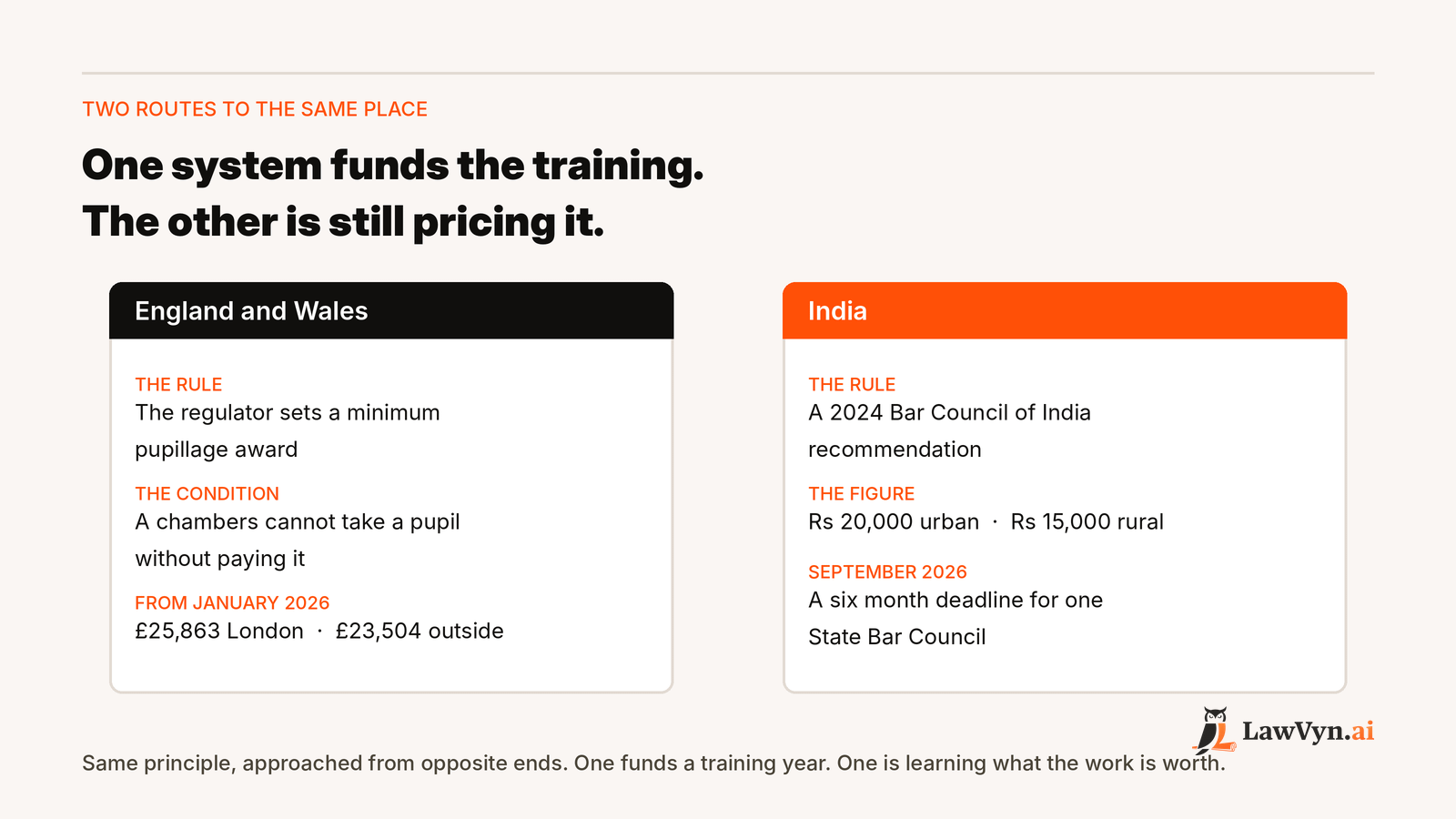
England and Wales took the opposite route to the same place. There the regulator sets a minimum pupillage award and a chambers cannot take a pupil at all without paying it. From January 2026 the figure is £25,863 in London and £23,504 outside it.
The amount is not the interesting part. The design is. A training year is funded as training, and the pupil’s time is meant to buy advocacy rather than administration. India is reaching the same principle from the other direction, with the courts pushing and the Bar Councils holding the pen.
What would make a floor worth paying
Three years should leave a lawyer holding things that are hard to pick up later. A feel for drafting. A sense of how a matter actually moves through a registry. The ability to read a bench. None of it is learned standing at a photocopier.
A guideline cannot move that load. It can only price it. The load moves when something else carries it. When a file has one home instead of six. When the current version of a draft is obvious without asking. When what is due on Monday announces itself, rather than waiting for someone to remember to look.
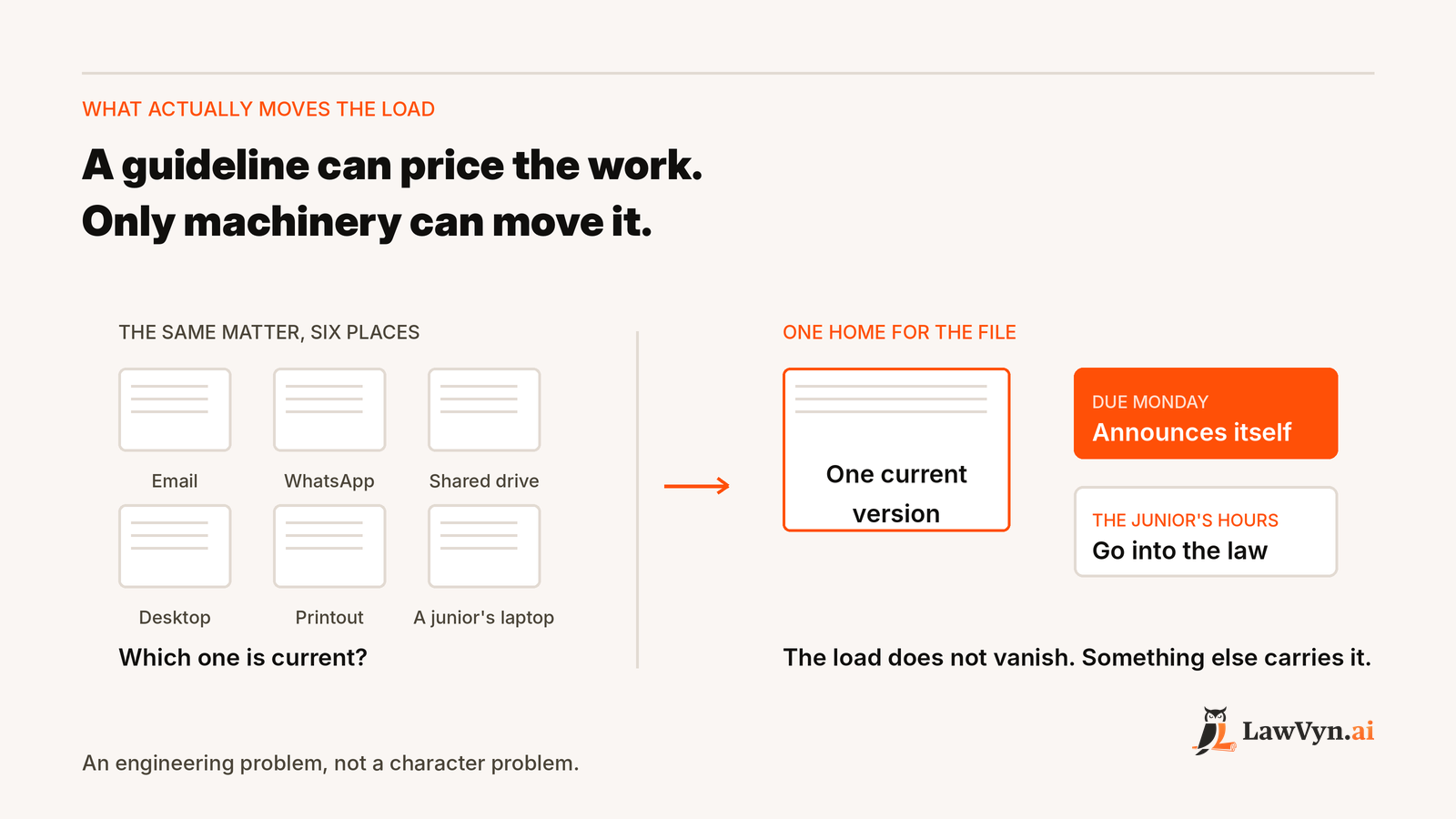
That is an engineering problem, not a character problem. Where the machinery exists, a junior’s hours go into law. Where it does not, they go into the registry and the photocopier, whatever the stipend happens to say.
Six months
The State Bar Council has six months to write a number.
Every chamber has the same six months for the harder question. Not what a junior should be paid. What we would want them to be able to say they learned.
Ravi Daparthi
CEO of LawVyn
A Practice management software for Indian advocates and law firms.
https://www.ravidaparthi.com/ ·
https://www.linkedin.com/in/ravidaparthi ·
Follow LawVyn on LinkedIn

This essay first appeared on my Substack. New pieces land there first.
Subscribe on Substack
Ravi Daparthi
Entrepreneur, AI product leader, CEO of LawVyn.ai. Co-founder of Signitives and Oorwin.
More from Ravi

Essay
Your Client Asked ChatGPT First. The Lawyer Is the Second Opinion.
Clients now arrive with an answer in hand. What that changes about trust, fees and what an advocate is really paid for.
1 October 2026 · 4 min read
Essay
A Lawyer's Computer Is Seized. Whose Privilege Walks Out?
A GST search of a Delhi advocate's office, a Supreme Court stay on Monday, and why Section 132 protects the conversation, not the computer.
30 September 2026 · 5 min read
Essay
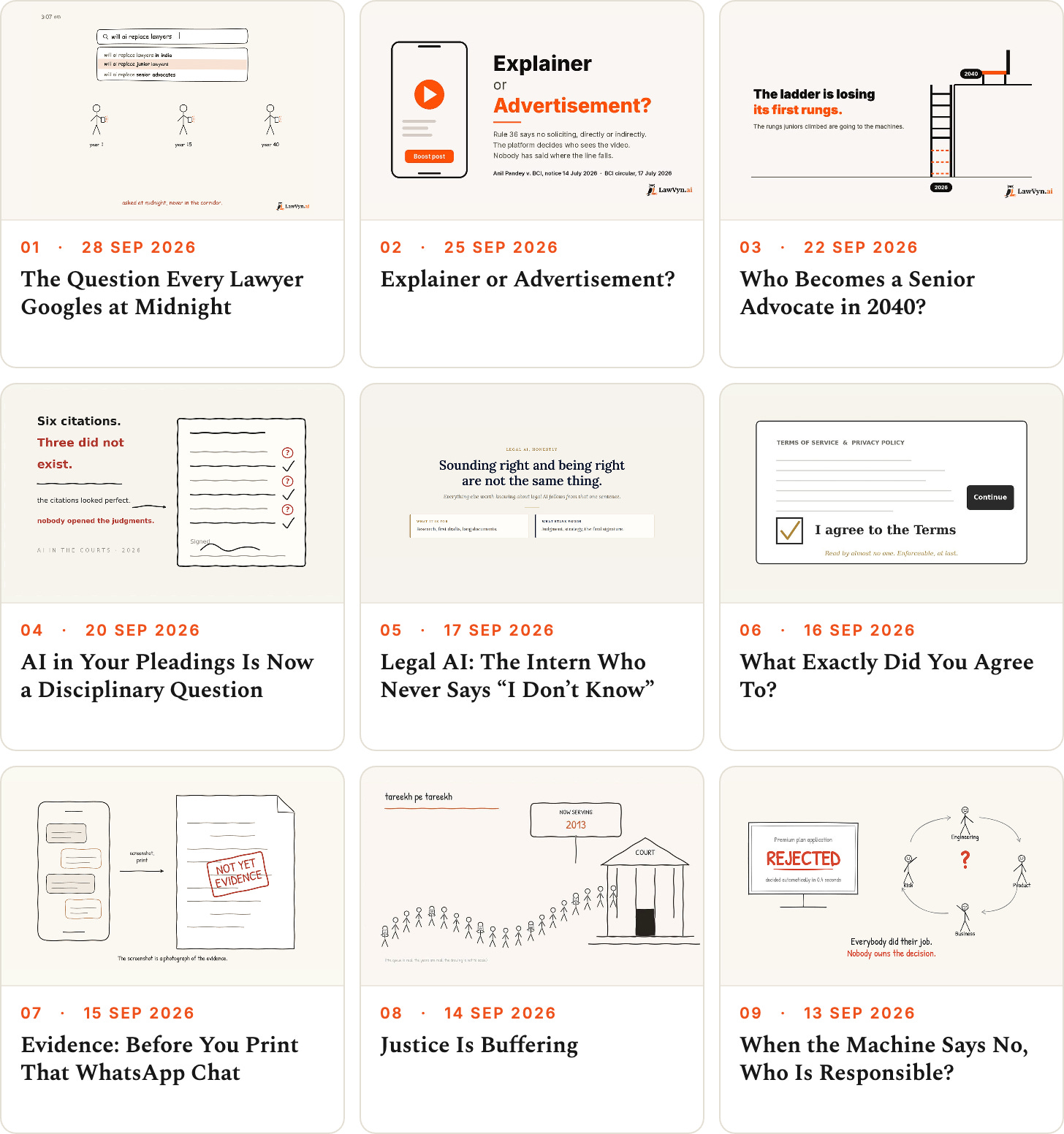
Nine posts, one grid, no scrolling required
The last two weeks, on one screen.
29 September 2026 · 1 min read