Essay · 30 September 2026 · 5 min read
A Lawyer's Computer Is Seized. Whose Privilege Walks Out?
A GST search of a Delhi advocate's office, a Supreme Court stay on Monday, and why Section 132 protects the conversation, not the computer.
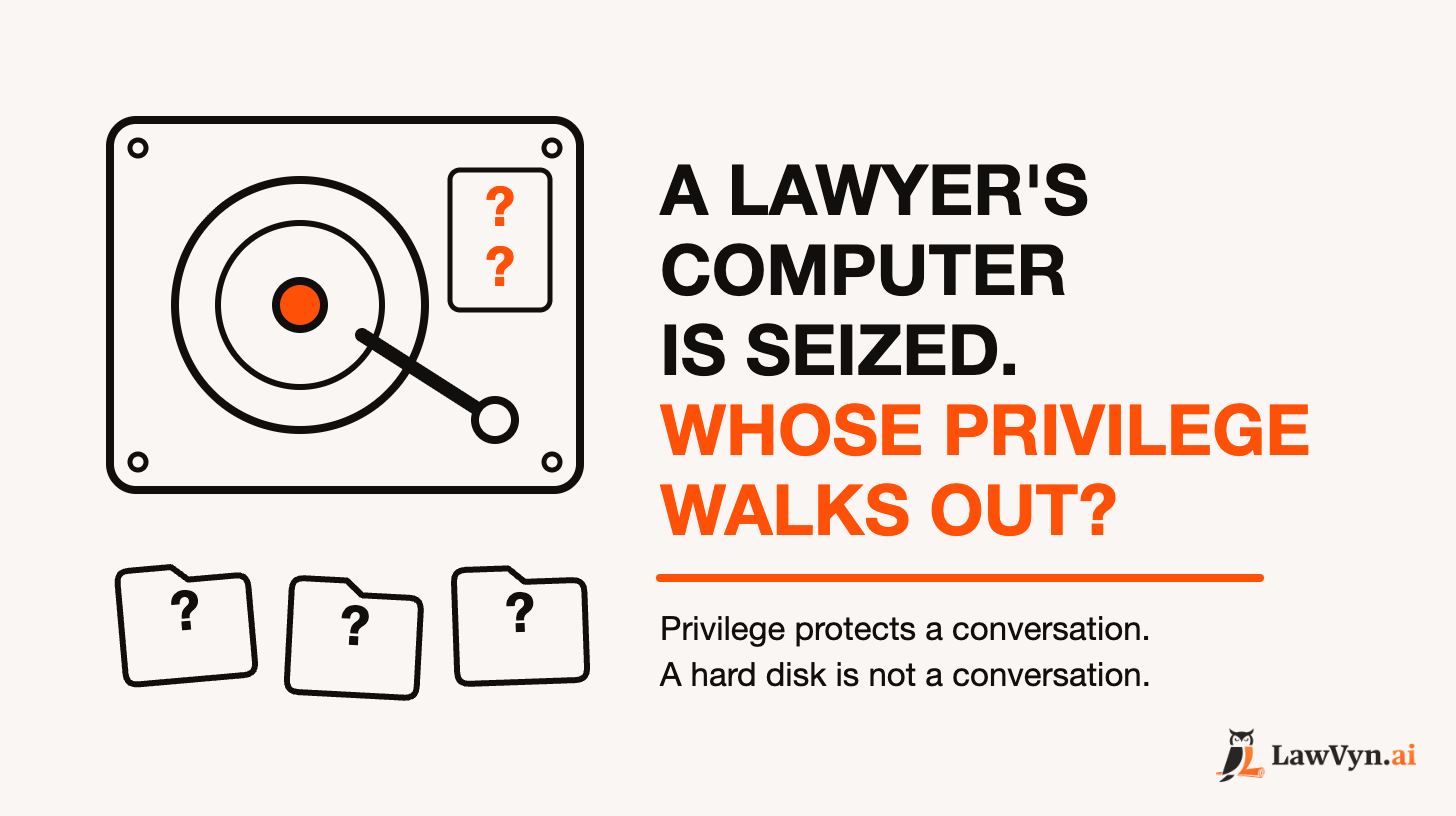
Last week, a senior advocate stood before the Chief Justice of India and made an argument that had nothing to do with tax law.
"If the entire data is accessed," he said, "I have got other clients also."
The matter is Puneet Batra v. Union of India. GST officers had searched a Delhi advocate's office under Section 67(2) of the CGST Act and taken away his CPU and documents. On 18 September, a Division Bench of the Delhi High Court dismissed his challenge. Privilege, the court held, attaches to the nature and circumstances of a communication. It does not automatically protect every document in an advocate's possession, and it cannot stop an investigation into the advocate himself when there is prima facie material suggesting his own role is part of the subject matter.
It is worth being precise about what the High Court did not do. It made no finding on the advocate's role. It also directed the department to work only from a cloned copy of the data and to confine itself to material relevant to the investigation, "without opening the data of other clients". On Monday, a bench of Justice Dipankar Datta and Justice Sheel Nagu stayed the judgment and gave the department three weeks to reply. Nothing about the advocate is decided, and nothing here should be read as suggesting otherwise.
But stay with that one sentence about other clients. It is not really a sentence about law. It is a sentence about hardware.
Privilege protects the conversation, not the computer
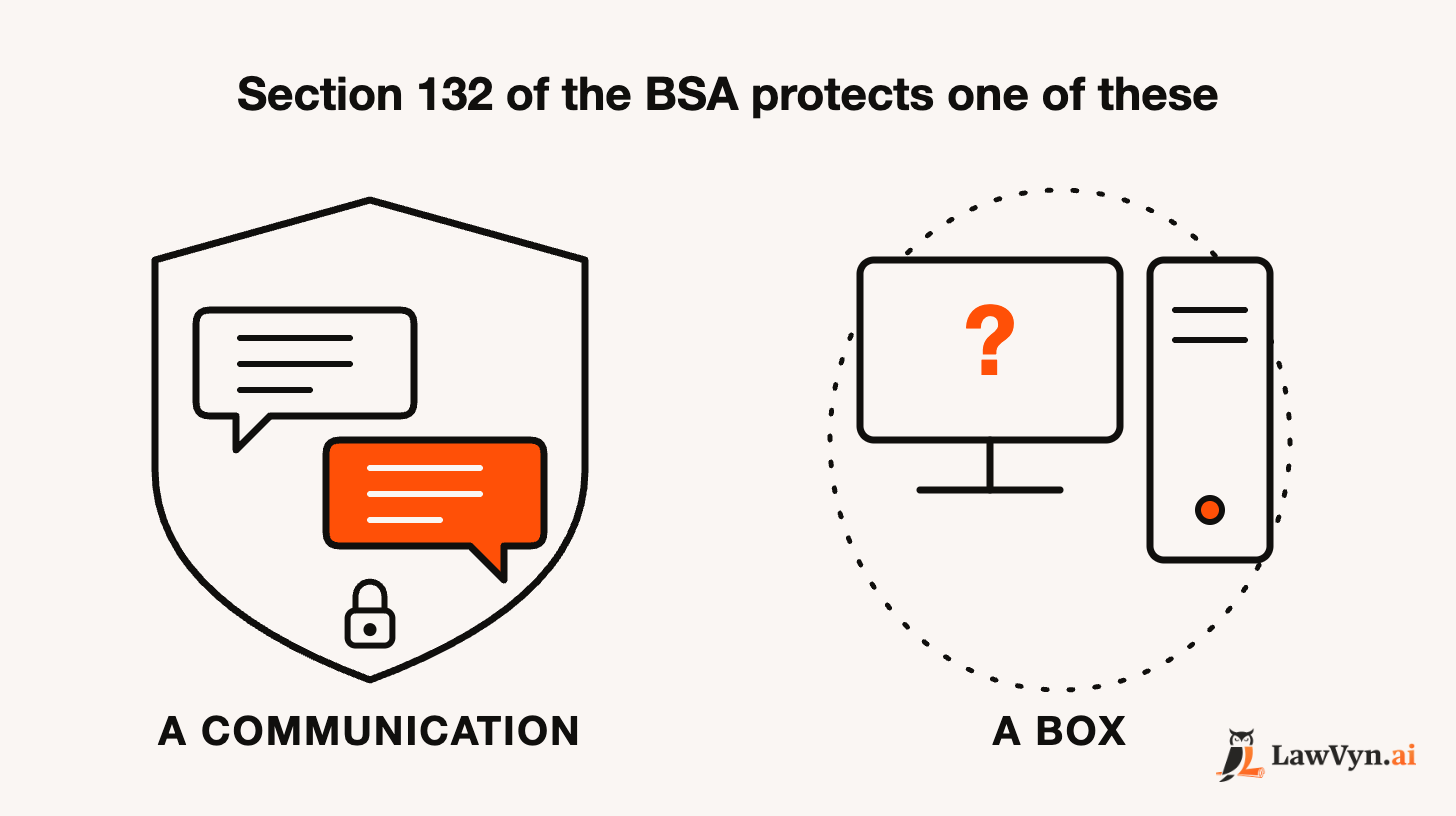
Section 132 of the Bharatiya Sakshya Adhiniyam, like Section 126 of the old Evidence Act before it, protects communications between an advocate and a client. The privilege belongs to the client. It has exceptions: the client can waive it, and it never covered a communication made to further an illegal purpose, or a crime or fraud the advocate noticed during the engagement.
What the section has never protected is a box. A CPU is not a communication. A hard disk is not a client. When a machine leaves an office, the law follows the conversations inside it one at a time and asks of each: was this privileged, and does an exception apply?
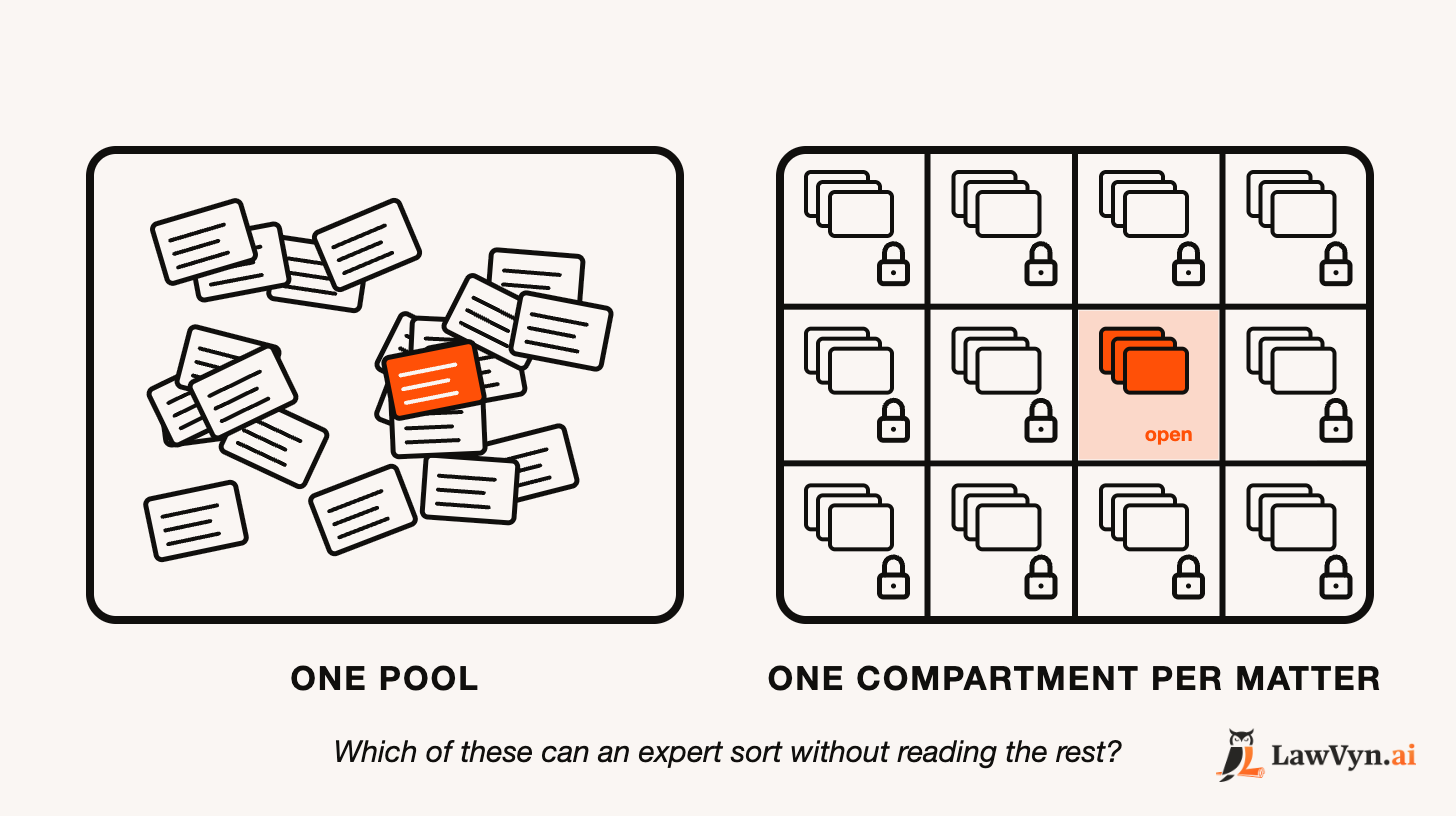
The trouble is that the machine has no idea. On a typical office computer, the confidential opinion for one client, the property file for another, the office accounts and the matter under investigation all live in the same flat pile of bytes. A cloned copy is a copy of everything. Whoever searches it for one matter is, physically, holding every other matter too.
Privilege was designed for paper files that could be picked up one at a time. Storage was designed to be cheap and flat. Nobody designed the two to meet.
The Supreme Court already wrote the procedure
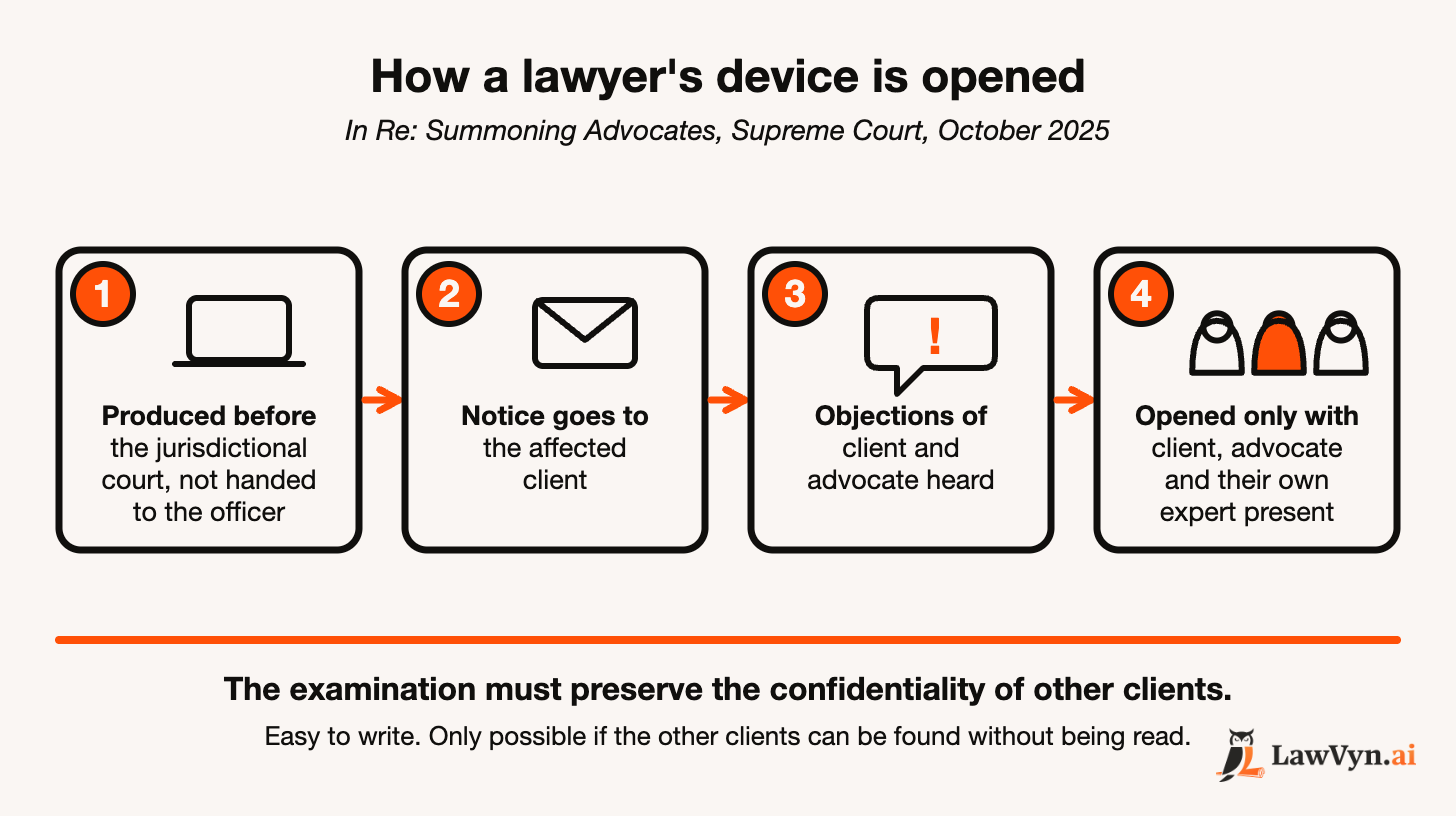
Last October, in In Re: Summoning Advocates, a three-judge bench led by the then Chief Justice B.R. Gavai laid down how this is meant to work. Investigating officers cannot summon an advocate to disclose what a client told them, except under the Section 132 exceptions, and even then only with a senior officer's written approval.
The judgment went further. Documents in an advocate's possession are not privileged by themselves; their production runs through the court, and the court decides. For digital devices the bench was specific. The device is produced before the jurisdictional court. The affected client gets notice. Objections are heard. If they are overruled, the device is opened only in the presence of the client and the advocate, each with a digital expert of their choice, and the examination must preserve the confidentiality of other clients.
Now read that with a real hard disk in mind. "Preserve the confidentiality of other clients" is easy to write in a judgment. It is only possible in practice if the other clients can be found and set aside without being read. On a machine where every file sits in one pool, the expert of your choice is being asked to un-mix paint.
Other countries met the same disk
Britain ran into this in 2001. Its Criminal Justice and Police Act gave investigators a "seize and sift" power precisely because a computer cannot be sorted on the doorstep. Officers may take the mixed lot, but legally privileged material must be returned. The law simply moved the sorting to a later stage, under supervision.
In the United States, when the FBI searched the office of Michael Cohen in April 2018, the court appointed a special master, a former judge, to screen every seized file for privilege before prosecutors could see any of it. Two systems, one instinct: put a neutral human between the pile and the investigator.
India has that instinct written into the October judgment, and both courts in the Delhi matter agree that other clients must stay closed. What remains open is who does the sorting when an officer arrives with a search authorisation rather than a summons. The Supreme Court bench has already said it cannot be the department alone.
What the office computer can answer
A search is a rare event. The structure it tests is an everyday one. Whether a system keeps each client's material in its own compartment, with access that can be shown and logged, decides what "I have got other clients also" means on the day someone finally asks.
If the system separates files by matter, the sentence is a fact the court can act on. An expert can lift one client's folder and leave the rest sealed. If the system keeps everything in one pool, the sentence becomes a plea, and the safeguards the Supreme Court wrote last October have very little to hold on to.
The law has done its part. It moved from paper to Section 132, and from summons to a courtroom procedure for devices. The hard disk has not moved at all. It still does not know which client is which, and it will not learn on its own.
Ravi Daparthi
CEO of LawVyn
A Practice management software for Indian advocates and law firms.
https://www.ravidaparthi.com/ ·
https://www.linkedin.com/in/ravidaparthi ·
Follow LawVyn on LinkedIn

This essay first appeared on my Substack. New pieces land there first.
Subscribe on Substack
Ravi Daparthi
Entrepreneur, AI product leader, CEO of LawVyn.ai. Co-founder of Signitives and Oorwin.
More from Ravi

Essay
Nine posts, one grid, no scrolling required
The last two weeks, on one screen.
29 September 2026 · 1 min read
Essay
The Question Every Lawyer Googles at Midnight
An honest answer from someone who builds the machines
28 September 2026 · 4 min read

Essay
Explainer or Advertisement? The Bar Council Read Your Instagram. So Did the Supreme Court.
A rule older than the internet, a 37-page circular, a Supreme Court notice to every State Bar Council, and a line nobody has drawn yet between teaching the law and selling it.
25 September 2026 · 5 min read