Essay · 20 September 2026 · 7 min read
AI in Your Pleadings Is Now a Disciplinary Question
A draft regulation in June, a Supreme Court judgment in July, and one clause that says you cannot blame the machine. Here is what changed, and what it asks of the advocate who signs.
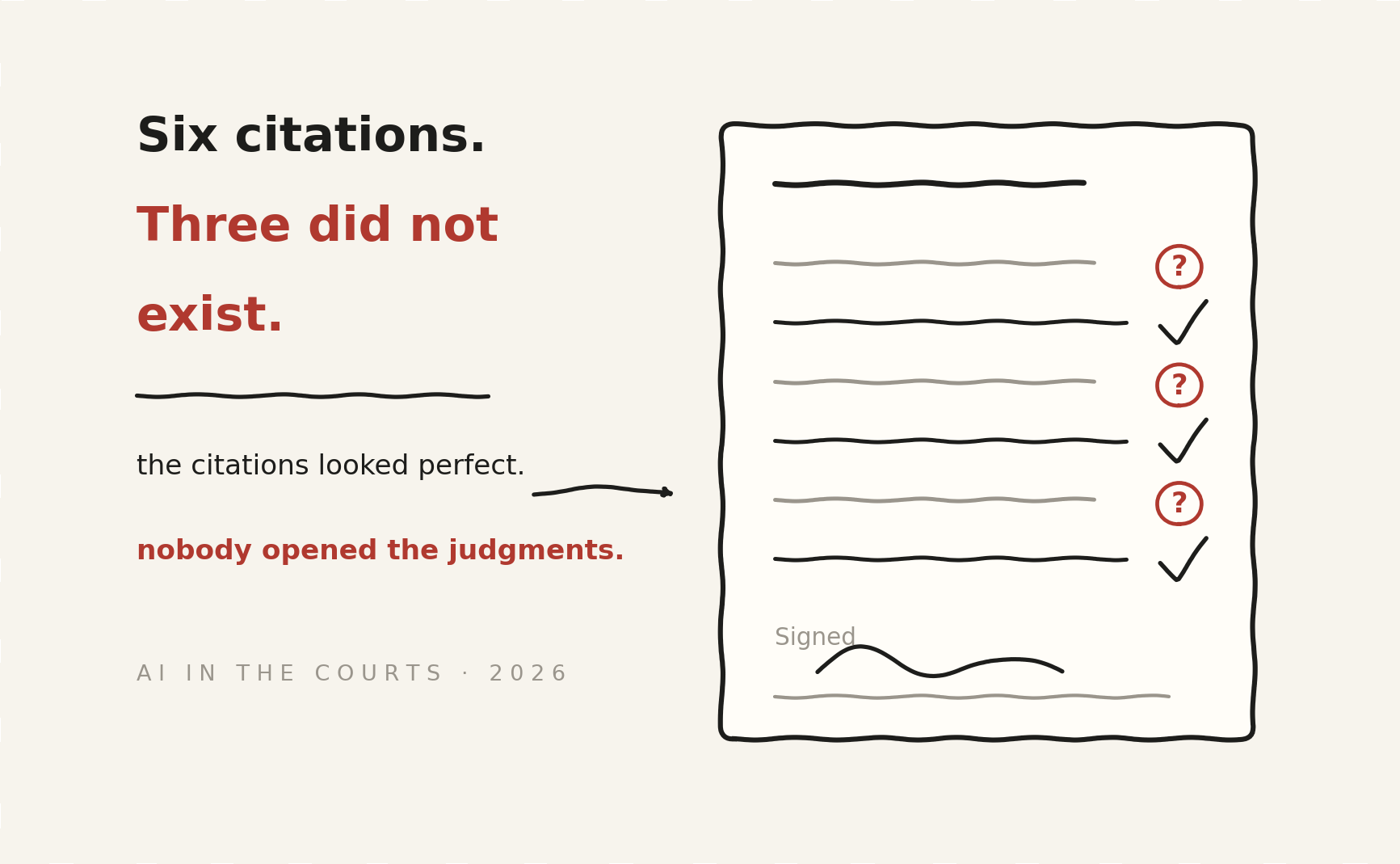
Imagine you are opposing counsel. The filing lands on your desk, forty-odd pages, properly made. You turn to the authorities, because that is where these things are won, and you look up the first case.
It is not there.
You check the year. You check the reporter. You wonder whether you have the name slightly wrong. It is simply not there. Neither is the third one, and the fifth exists but says nothing like what has been quoted from it.
Somebody in that chamber typed a proposition into a tool, got back citations that looked immaculate, and filed them. Nobody opened the judgments.
That is not a hypothetical. This July it happened in a matter that reached the Supreme Court.
The six citations
In Pooja Ramesh Singh v. Jammu and Kashmir Bank, decided on 2 July 2026, a bench of Justices P.S. Narasimha and Alok Aradhe examined an NCLT order resting on six precedents. Some of them did not exist. Others existed, but the paragraphs quoted from them did not. The appellate tribunal had caught none of it.
The Court set the orders aside, and then said something that will be quoted for a long time. A decision built on material that is fake and hallucinated, it held, is no decision at all, and amounts to subversion of the rule of law.
It went further. Citing invented precedents was treated as misconduct on the part of the advocate, and the Bar Council of India was directed to constitute a committee, frame guiding principles, and settle what discipline follows a breach.
Then came the line that gives away what this really is. The Court compared fabricated citations to the release of methyl isocyanate in the province of law and justice. Invisible, insidious, catastrophic.
A judge reached for Bhopal. That is not a man worried about a software bug.
It was not the first warning either. In February, a bench led by the Chief Justice of India was shown a case called Mercy vs Mankind. Justice Nagarathna observed that it does not exist. Around the same stretch, a High Court imposed costs on a litigant who leaned on a judgment nobody could find, and tax orders running into crores have been undone because the authorities behind them were imaginary.
The clause that changes the economics
On 3 June 2026 the Supreme Court’s AI Committee released draft Regulations for the Use of Artificial Intelligence in Courts, 2026, and opened them to public comment.
Most of the coverage went to what judges may not do. They may not use AI to decide a case, to grant or refuse bail, to fix a sentence, to weigh whether a witness is telling the truth, or to predict what an accused will do next. Opaque risk scoring is out. Research, translation, transcription, scheduling, citation checking and drafting support are all in.
Fair enough. But the clause that should occupy the Bar is quieter.
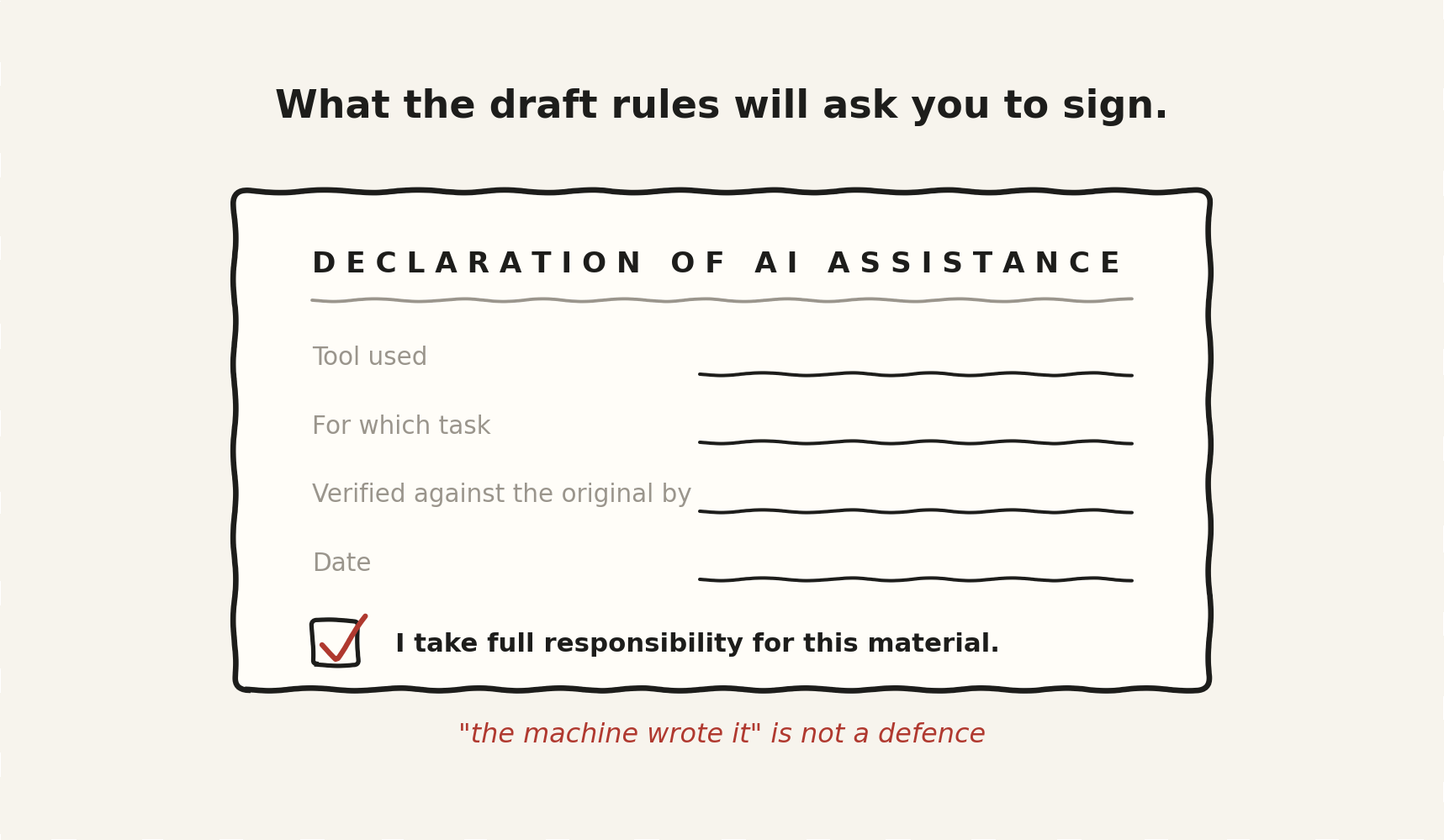
AI-assisted material is to be disclosed to the court at the time of submission, through a declaration in a prescribed form. And under Regulation 43(6), anyone who places material that is fabricated, false, misleading or inaccurate by reason of its AI-generated character before a court bears full responsibility for it, and is not entitled to rely on the character of the AI output as a defence.
Read that again, slowly, as a practitioner.
The draft does not ask whether you used AI. It assumes you did. It asks whether you checked.
What was actually automated
The profession has spent two years arguing about the wrong question. Will AI replace lawyers. It is a comfortable question, because the answer is always no, and everybody goes home reassured.
Here is the harder one. Which part of a lawyer’s work was ever scarce?
Not the drafting. A well-built petition has a form, and forms can be learned. Not the research note. Not the first cut of a contract, not the chronology, not the summary of the law. Those took time, and time is what we billed, but they were never the scarce thing.
The scarce thing was judgment. And sitting underneath judgment is an unglamorous foundation nobody has ever been paid for separately: verification. Opening the actual paragraph. Checking whether the case still stands. Noticing that the proposition your authority supports is close to yours but not the same.
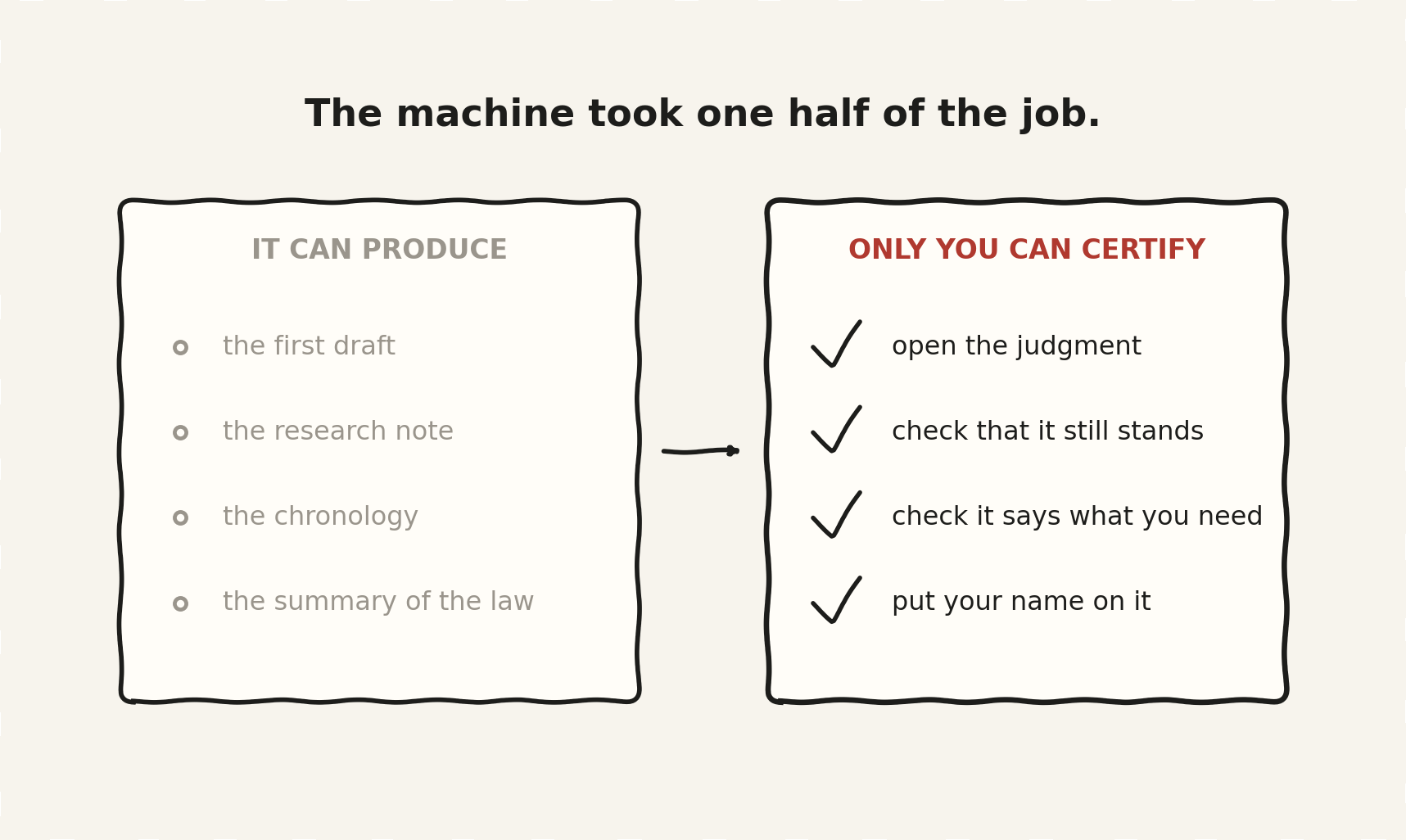
The machine has taken the production. It has not taken, and cannot take, the verification. What it has done is make verification far more necessary and far less obvious, because the output no longer looks like a draft. It looks like a finished product. Confident, formatted, paragraph numbered.
That is the trap. Bad work used to look bad. It does not any more.
We had this habit before the machine
I want to be careful here, because there is a version of this argument that lets the profession off too easily.
The machine did not invent the shortcut. Anyone who has spent time around litigation knows that citations have travelled from filing to filing for decades, lifted from an earlier petition, picked off a headnote, borrowed from a digest, passed down through three juniors without one of them opening the judgment. A headnote is somebody else’s summary. We trusted it because the somebody was a publisher rather than a model.
AI did not create that habit. It industrialised it. It took a shortcut a careless lawyer could manage four times a week and made it available four hundred times a day, in prose good enough to survive a skim.
Which means the correction cannot be a rule about tools. It has to be a rule about reading.
What a practice can do about it now
Three things, none of which need a budget.
Make verification a named step with a named owner. Not an assumption, not something that obviously happens. If a citation leaves your office inside a filing, somebody has opened the judgment, and that somebody has a name. Juniors should be told plainly that producing the draft is the easy half of the job.
Keep a record. Which tool, for what task, what was checked, by whom. When disclosure becomes mandatory, and it will, the chambers that have been keeping notes will treat it as an administrative task. The rest will treat it as a reconstruction exercise, which is a polite phrase for guessing.
Think hard about what leaves your office. Client files, case notes, opinions, personal details belonging to people who agreed to none of this, pasted into a general purpose tool hosted somewhere you have never thought about. Privilege is not suspended because the interface is convenient. This is the part of the conversation the Indian Bar has barely begun.
The signature at the bottom
The rest of the world got here a little earlier. The American Bar Association issued formal ethics guidance on generative AI in July 2024, and the Bar in England and Wales has been guiding its members and revising that guidance as the tools changed. India arrived quickly once it arrived: a draft regulation in June, a Supreme Court judgment in July, barely a month apart.
All of them land in the same place. The tool assists. The advocate answers.
I build software for Indian advocates, so I am not going to tell you these tools are dangerous. They are not. Used well, they will do more for a two-person chamber in a district town than most reforms of the last twenty years. A lawyer who could never afford a research team now has one.
What decides the worth of that research team is who reads it before it goes in.
For a very long time, a lawyer was paid for what he produced. From here, he will also be paid for what he is willing to certify.
The machine will keep writing, and it will keep sounding certain. It will hand you six authorities before you finish reading this sentence, and most of them will be sound.
The signature at the bottom of the filing is still yours.
Ravi Daparthi
CEO of LawVyn
A Practice management software for Indian advocates and law firms.
https://www.ravidaparthi.com/ ·
https://www.linkedin.com/in/ravidaparthi ·
Follow LawVyn on LinkedIn

This essay first appeared on my Substack. New pieces land there first.
Subscribe on Substack
Ravi Daparthi
Entrepreneur, AI product leader, CEO of LawVyn.ai. Co-founder of Signitives and Oorwin.
More from Ravi
Essay
Legal AI : The Intern Who Never Says “I Don’t Know”
Legal AI drafts fast, reads faster, and will invent a judgment with a straight face. Here is how to pick one you can trust with a client file.
17 September 2026 · 5 min read
Essay
What Exactly Did You Agree To?
India's data law is now live, machines are making decisions about you, and the box you tick without reading has quietly started to matter.
16 September 2026 · 8 min read
Essay
Evidence: Before You Print That WhatsApp Chat
Two election petitions, one borrowed British rule, and a certificate that now needs a hash value. What every Indian lawyer should know about electronic evidence in 2026.
15 September 2026 · 6 min read