Essay · 7 October 2026 · 6 min read
A Law Firm’s Memory Has a Notice Period
Every chamber and law firm owns an asset that never appears on a balance sheet. It lives in people, and people move.
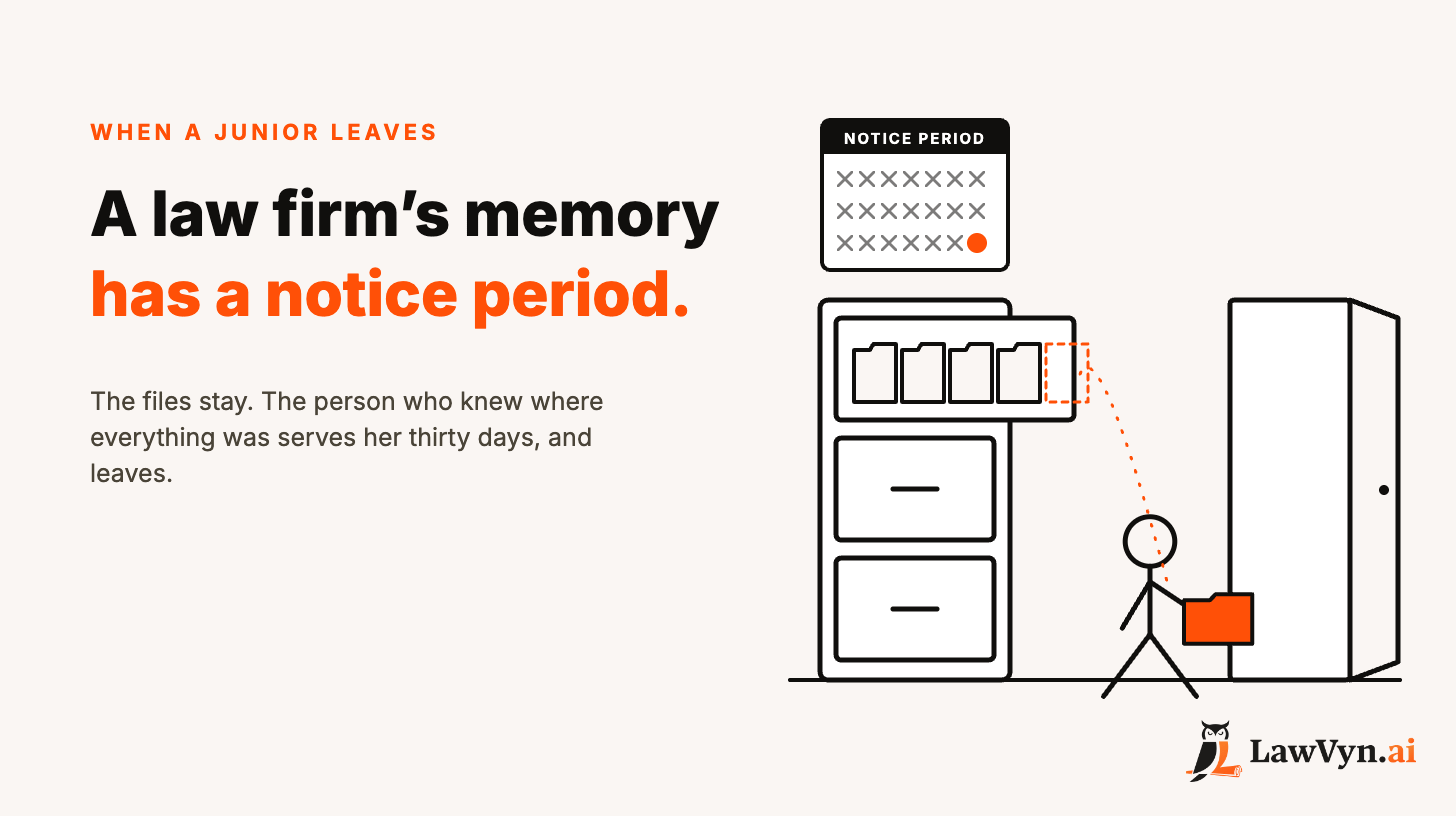
Imagine a Tuesday morning in a mid-sized firm. A junior who has handled the firm’s arbitration matters for three years has put in her papers. Her last day is Friday.
The partner is right not to worry about the matters. The files are in the cupboard, the pleadings are on the server, the dates are in the diary.
By the next month the worry arrives in small doses. Which version of the Section 9 petition did we finally file? Where is the note on the High Court order that saved us a limitation argument? Why does the new draft read as if a different firm wrote it?
Nothing was lost. Everything is still in the office. It just stopped being findable, because the person who knew where it was has gone.
I have seen versions of this in every kind of practice, from a two-table chamber to a firm with a floor of its own. The asset is the same. So is the leak.
The asset nobody counts
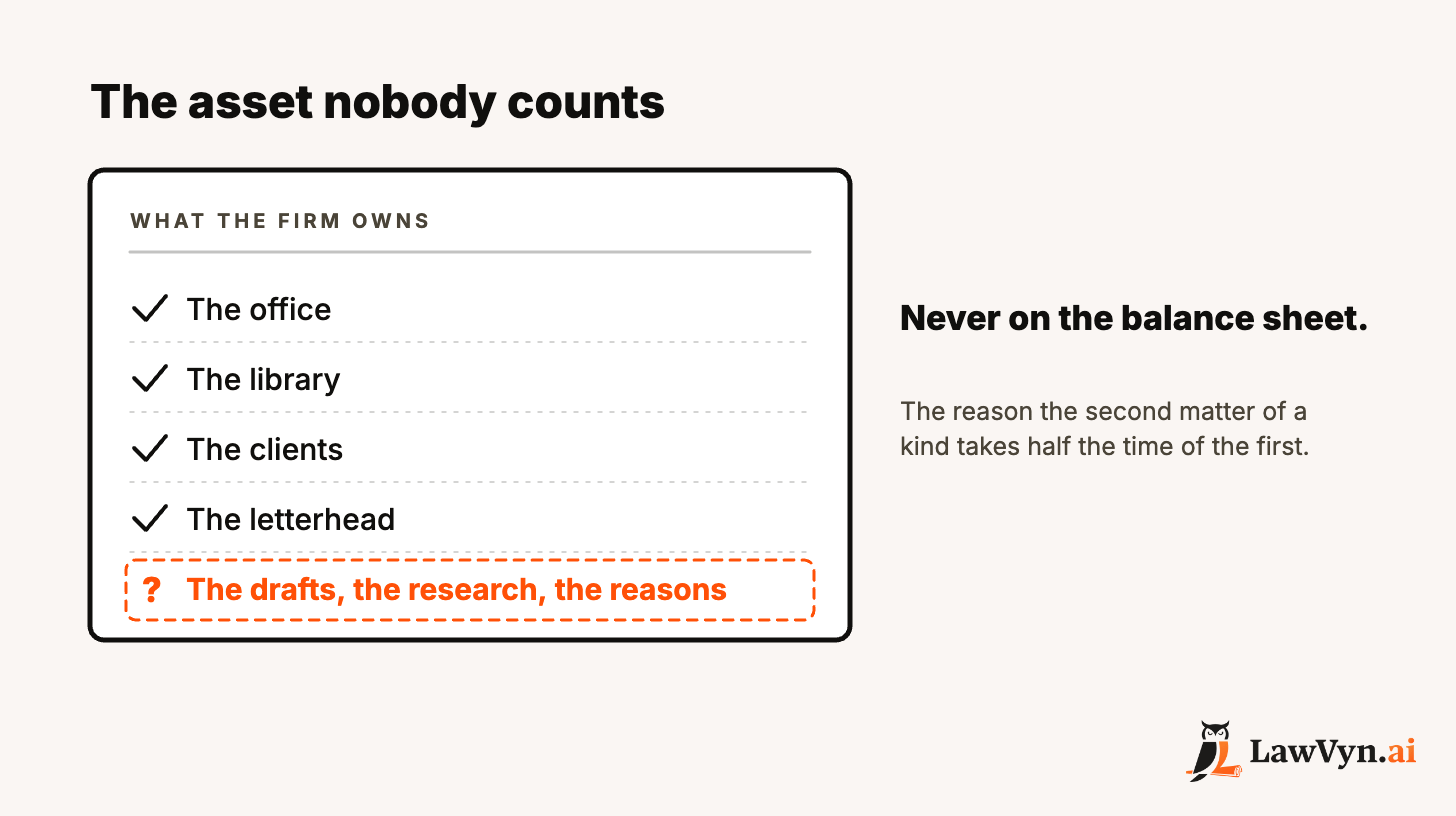
Ask a firm what it owns and it will list the office, the library and the clients.
It rarely lists the thing that actually produces the work: the drafts that were argued and survived, the research notes that killed a weak point before it reached the bench, the memory of what a particular court accepts, the email that explains why clause 14 was worded that way.
That is the firm’s memory. It is the reason the second matter of a kind takes half the time of the first.
The trouble is where it lives. Not in the cupboard, not on the server. In people. In the junior who drafted it, the associate who found the judgment, the senior who remembers the argument from 2016.
And people move.
People move. That is the job.
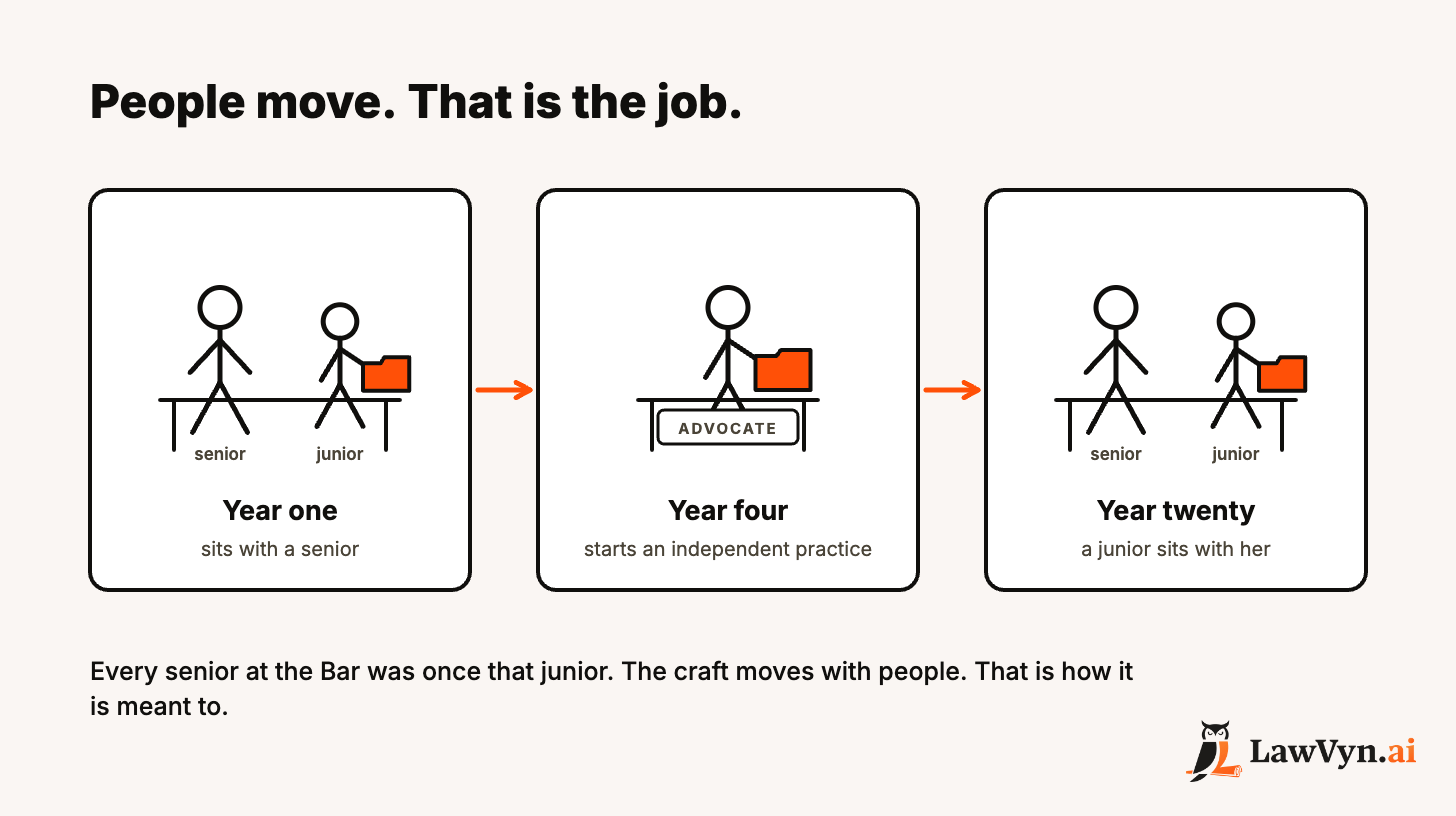
This is not a complaint about juniors. Moving is how the profession is built. A junior sits with a senior for a few years, learns the craft, and then starts an independent practice or joins another chamber.
Every senior at the Bar was once that junior, and most carry the name of the senior they sat with for life.
The numbers abroad show how fast the churn has become. A 2025 survey of more than 800 senior figures at UK and US firms found that 16 per cent of junior associates had left private practice in the previous twelve months, up from 9 per cent a year earlier. It priced each departure, in lost revenue, recruitment and training, at up to a million dollars.
India does not publish a figure like that. Anyone who runs a chamber does not need one.
The system was built around one kind of memory: the senior’s, which is the deepest in the room. It was never built to hold what the junior learned alongside it.
Three things that walk out
What leaves is rarely dramatic. It is three ordinary things.
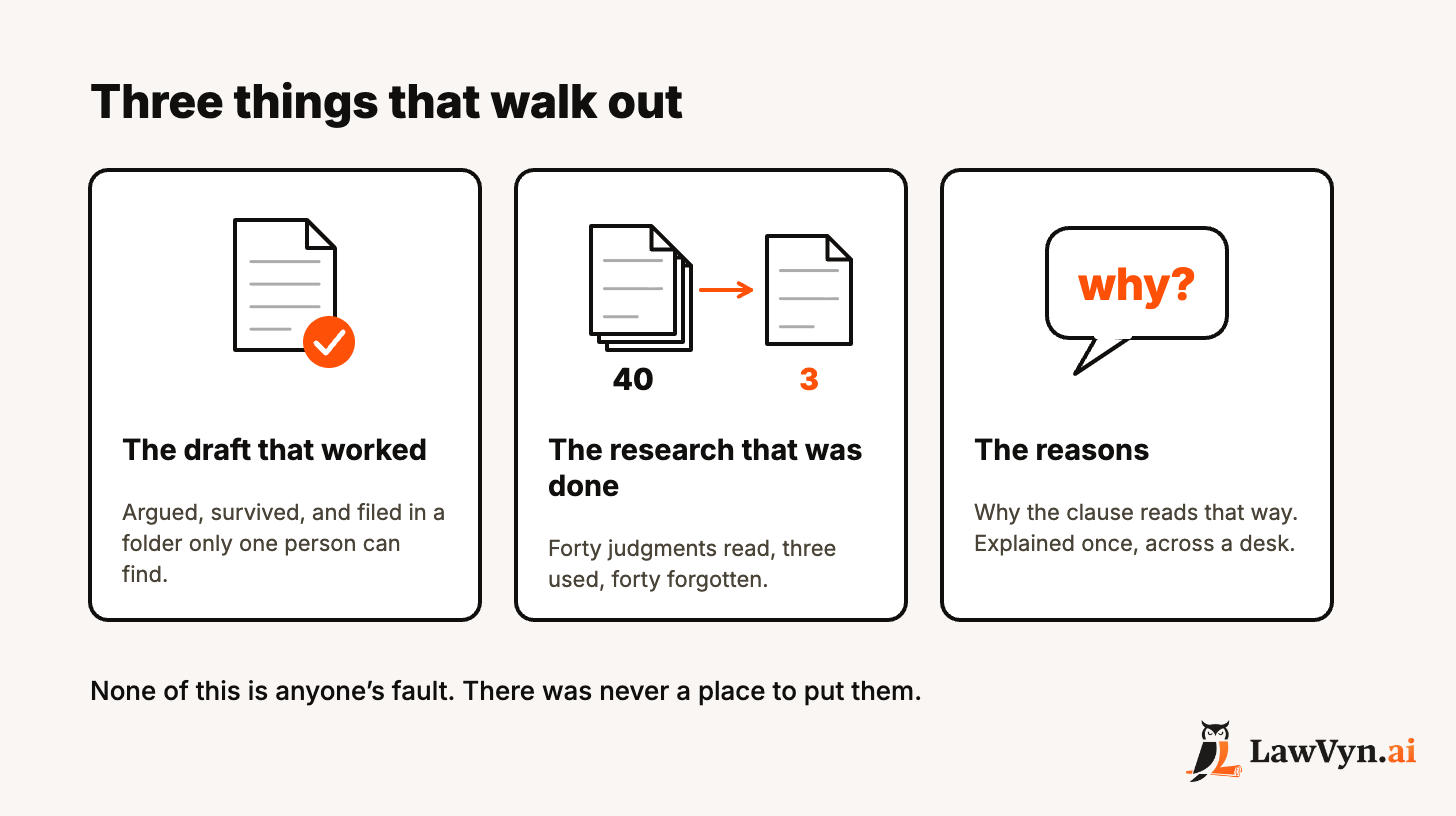
The draft that worked. Every chamber has a petition that got relief, a reply that closed a point, an agreement that survived a dispute. These are precedents in the truest sense, and they belong to the firm. They sit in a folder named after a client, which only the person who made the folder can find.
The research that was done. A junior spends a weekend reading forty judgments to find the three that matter. The three go into the written submissions. The forty go nowhere. The next junior, in the next matter, reads them again.
The reasons. Why was this clause drafted this way? Why did we not press that ground? Reasons are the most valuable memory and the least recorded, because they were explained once, across a desk, and that was that.
None of this is anyone’s fault. There was never a place to put them.
The courts fixed their memory first
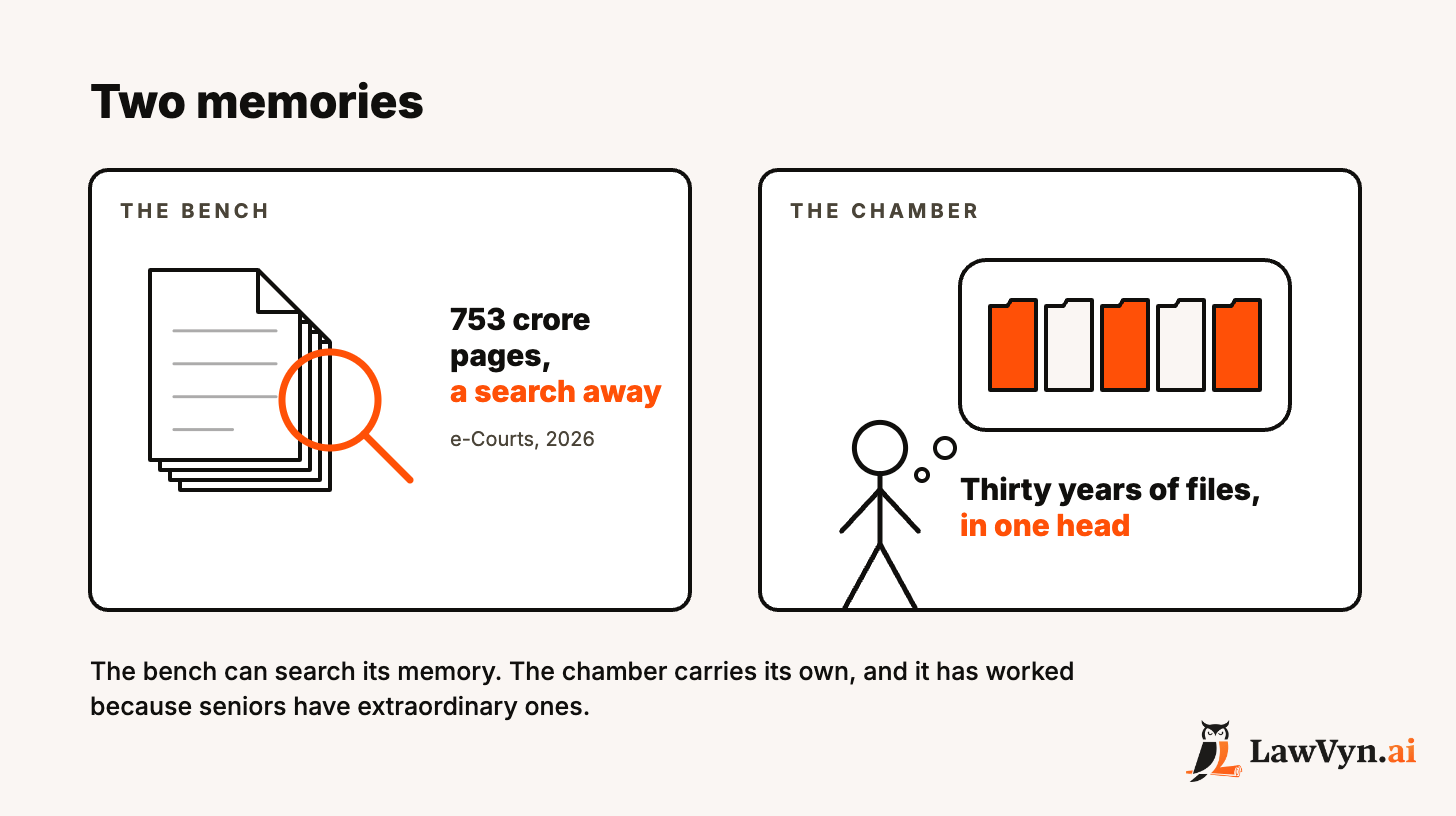
Here is a comparison worth sitting with. Indian courts have digitised more than 753 crore pages of records under the e-Courts project. An order from fifteen years ago is a search away.
The bench, in other words, has a memory it can search. The chamber on the other side of the courtroom carries its memory in people’s heads, which has worked for a century because seniors have extraordinary ones. It is still a lot to ask of any one head.
Firms in the United Kingdom noticed this gap in the early 1990s and created a job for it: the professional support lawyer, a qualified lawyer whose entire role is to keep the firm’s precedents and know-how current. Three decades later, that work is moving into software.
In India the shift has started at the top. One of the country’s largest firms told Mint in December 2025 that more than 80 per cent of its people now use AI tools, mostly for research, drafting and finding what the firm already knows, with time savings of 20 to 30 per cent on research and documentation.
The tools have changed shape too. The first generation was a document management system, a better cupboard. The current generation reads the firm’s own documents, so “what did we argue on limitation in that arbitration” is answered from the firm’s own files, not from the internet. Drafting starts from the firm’s own templates. A junior who leaves still leaves. The forty judgments and the reasons stay.
The regulators have noticed too
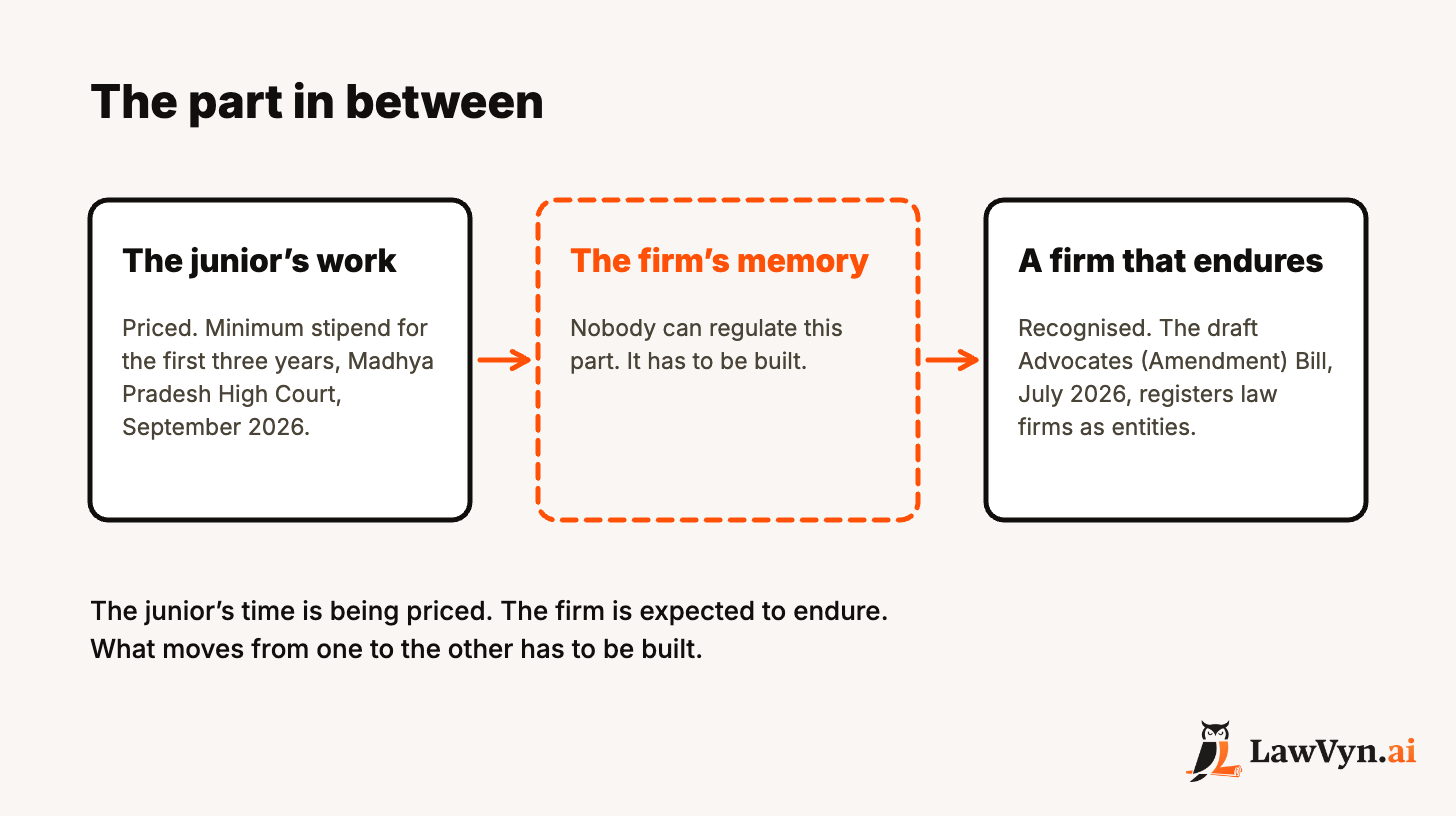
Two developments this year assume something new: that a law firm is an institution, not a group of individuals sharing a letterhead.
In July 2026 the Bar Council of India released the draft Advocates (Amendment) Bill, which for the first time proposes statutory recognition of law firms and their registration with Bar Councils. An entity that registers is an entity expected to keep records, to outlast its members, to have a memory.
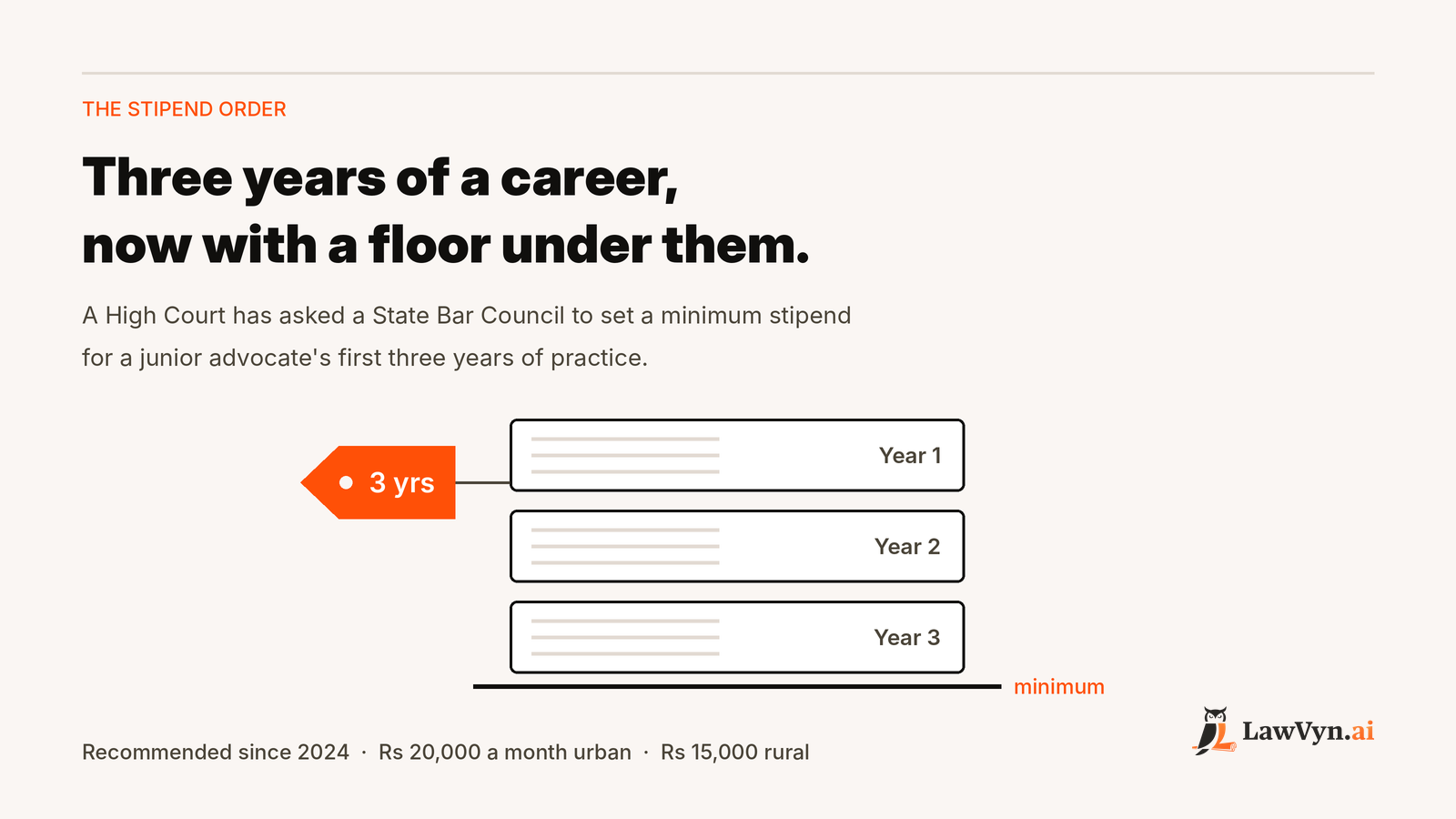
In late September 2026 the Madhya Pradesh High Court directed the State Bar Council to frame guidelines, within six months, for a minimum stipend to junior advocates in their first three years, relying on the Bar Council of India’s circular of October 2024 that recommended Rs 20,000 a month in urban areas and Rs 15,000 in rural ones. The order recognised that a junior’s early years are working years, not only learning years.
Put the two together. The junior’s time is being priced. The firm is being treated as something that should endure. The one thing in between, the knowledge that moves from the junior’s work into the firm’s permanent memory, is the part nobody can regulate. It has to be built.
What stays when they go
This is not only a software question. A chamber where the senior explains the reasons, and a junior who writes them down, will outperform a firm with an expensive system and no habit of using it.
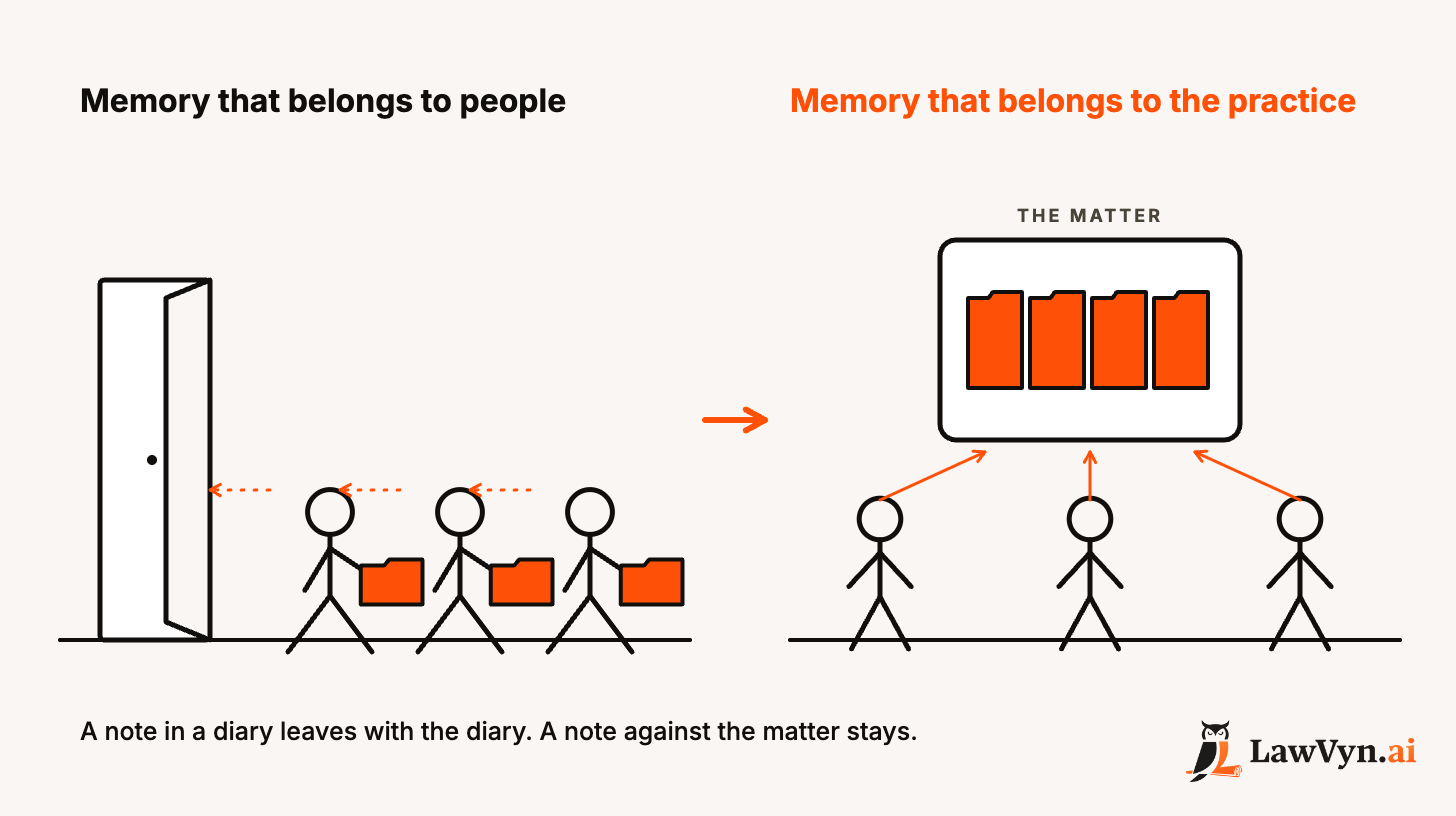
But habits need somewhere to land. A note in a personal diary leaves with the diary. A note written against the matter, in a place the whole firm can search, stays.
That is the whole shift. From memory that belongs to people to memory that belongs to the practice.
To the junior reading this: the research you do this weekend is worth more than this one matter. Put the forty judgments somewhere the firm can find them. It is the most senior thing you will do this year.
To the partner: the arbitration junior will leave one day, as you once did. The question is not how to keep her. It is how much of what she learned under you the firm gets to keep.
Nobody plans for the Friday. Everybody feels the month after.
Ravi Daparthi
CEO of LawVyn
A Practice management software for Indian advocates and law firms.
https://www.ravidaparthi.com/ ·
https://www.linkedin.com/in/ravidaparthi ·
Follow LawVyn on LinkedIn

This essay first appeared on my Substack. New pieces land there first.
Subscribe on Substack
Ravi Daparthi
Entrepreneur, AI product leader, CEO of LawVyn.ai. Co-founder of Signitives and Oorwin.
More from Ravi
Essay
A Junior Advocate's First Three Years Now Have a Price
A High Court has given a State Bar Council six months to set a minimum stipend. The money question hides a harder one about what those three years are actually made of.
4 October 2026 · 4 min read
Essay
Your Client Asked ChatGPT First. The Lawyer Is the Second Opinion.
Clients now arrive with an answer in hand. What that changes about trust, fees and what an advocate is really paid for.
1 October 2026 · 4 min read
Essay
A Lawyer's Computer Is Seized. Whose Privilege Walks Out?
A GST search of a Delhi advocate's office, a Supreme Court stay on Monday, and why Section 132 protects the conversation, not the computer.
30 September 2026 · 5 min read