Essay · 20 October 2026 · 5 min read
“Have We Acted for the Other Side?” Every Advocate Answers From Memory.
Rule 33, a 1983 suspension and a 2026 Supreme Court judgment say what an advocate owes a former client. The check that enforces it still runs on one person's memory.
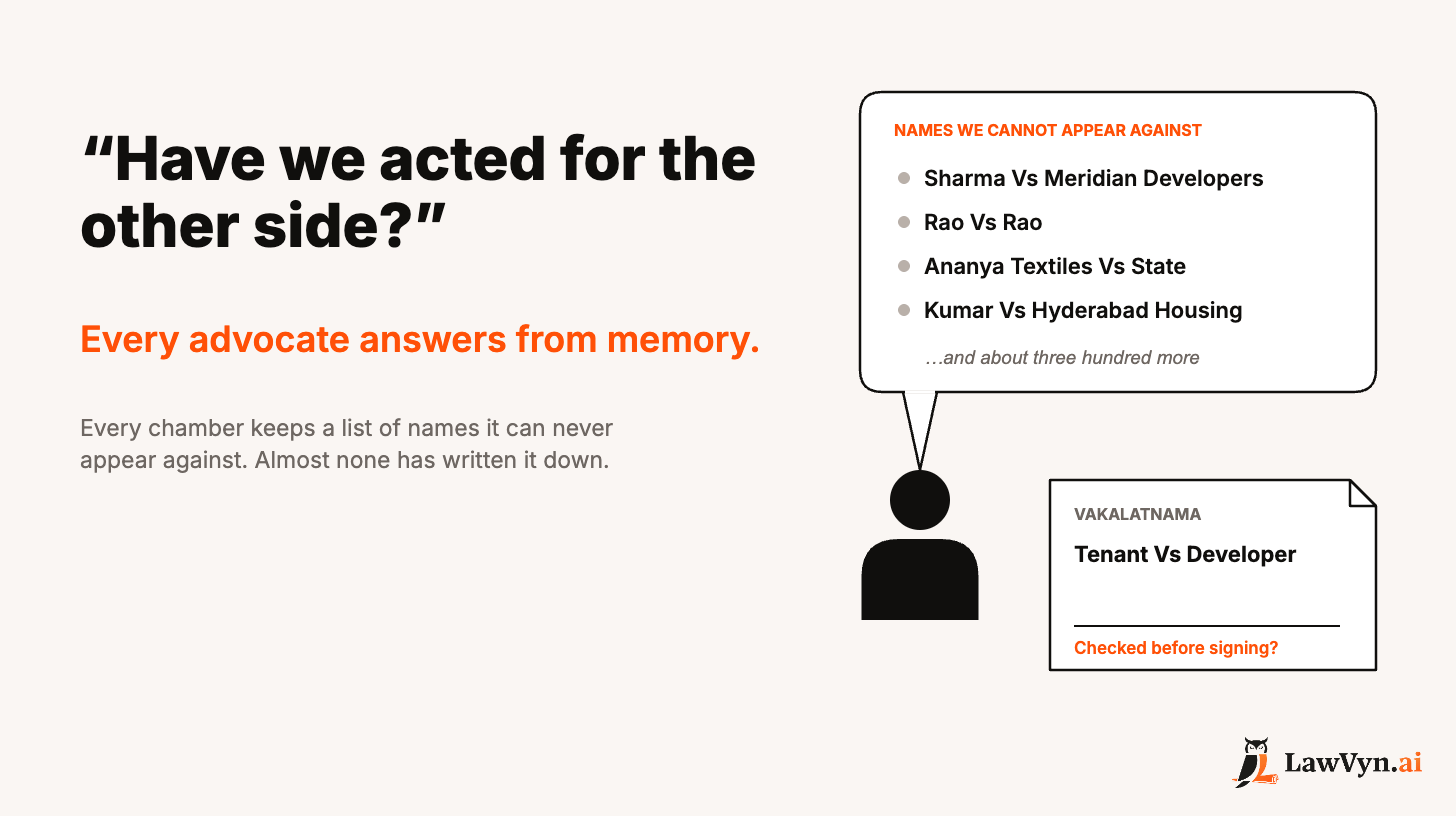
Every chamber has a list of names it can never appear against. Almost none has written it down.
The list is not a courtesy. It is a Bar Council rule, a Supreme Court suspension, and, since August, a Supreme Court judgment on what a client's confidence is worth after the brief ends.
It is also the only part of a practice still run from memory.
In most chambers the conflict check is a question asked across a room: have we ever acted for the other side? The answer comes from whoever has been there longest, and it is almost always right. The question is what the practice rests on when that person is in court.
One sentence, since 1975
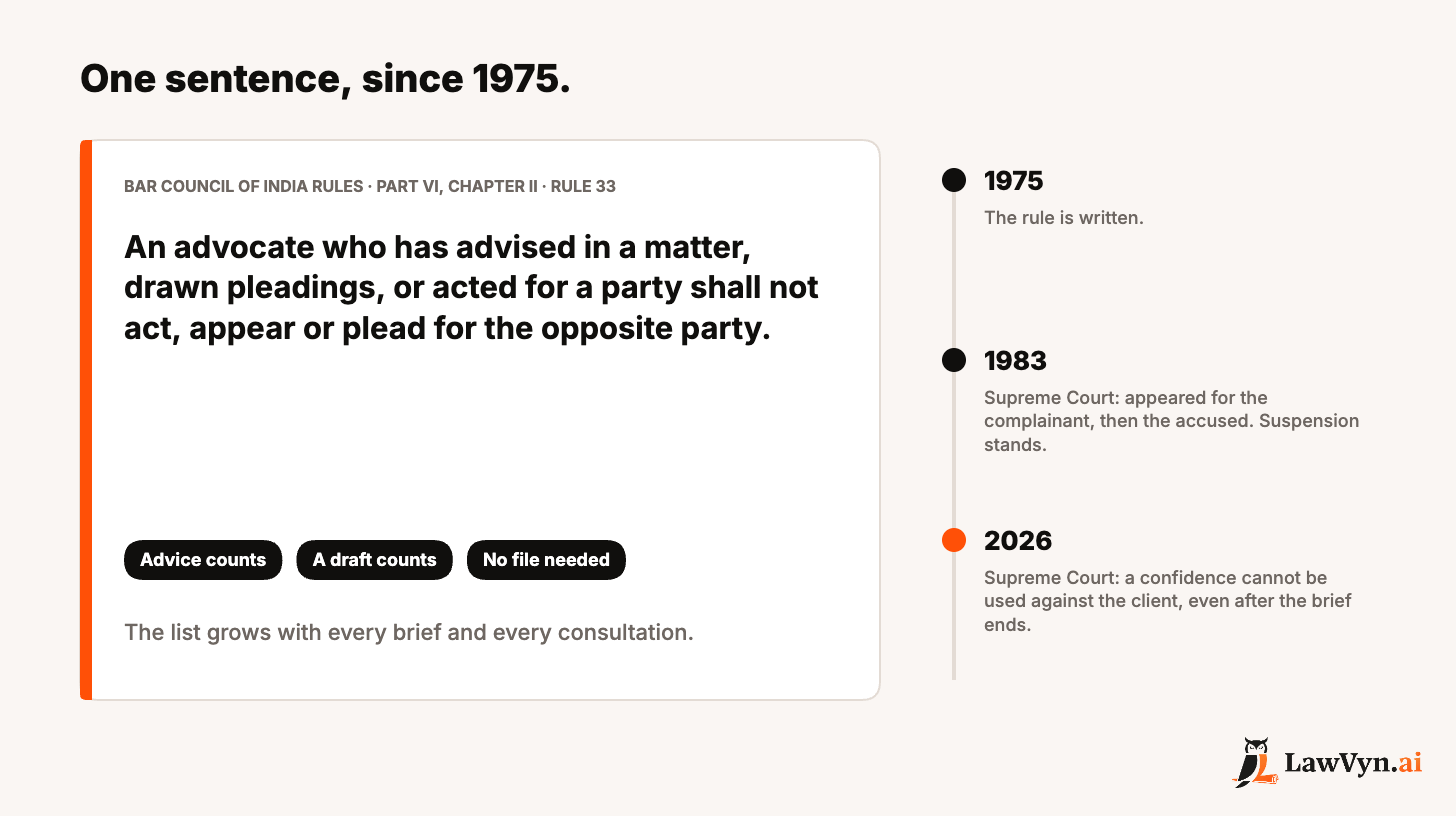
Rule 33 of the Bar Council of India Rules: an advocate who has advised in a matter, drawn pleadings, or acted for a party shall not act, appear or plead for the opposite party.
Advice counts. A draft counts. The file need never have been opened.
The Supreme Court applied it in 1983 to an advocate who appeared for the complainant in a criminal case and then accepted the accused's brief. The suspension stood: it is unprofessional, the Court said, to represent conflicting interests without express consent.
In August 2026 the Court added the other half. An advocate cannot use information received in confidence against a client, and that duty does not end when the engagement does.
Together they make the list longer than any chamber thinks: every client, every opposite party, and everyone who ever sat across the desk for an opinion. It grows with every brief. It never gets shorter.
Nineteen rules for an arbitrator, one sentence for the advocate
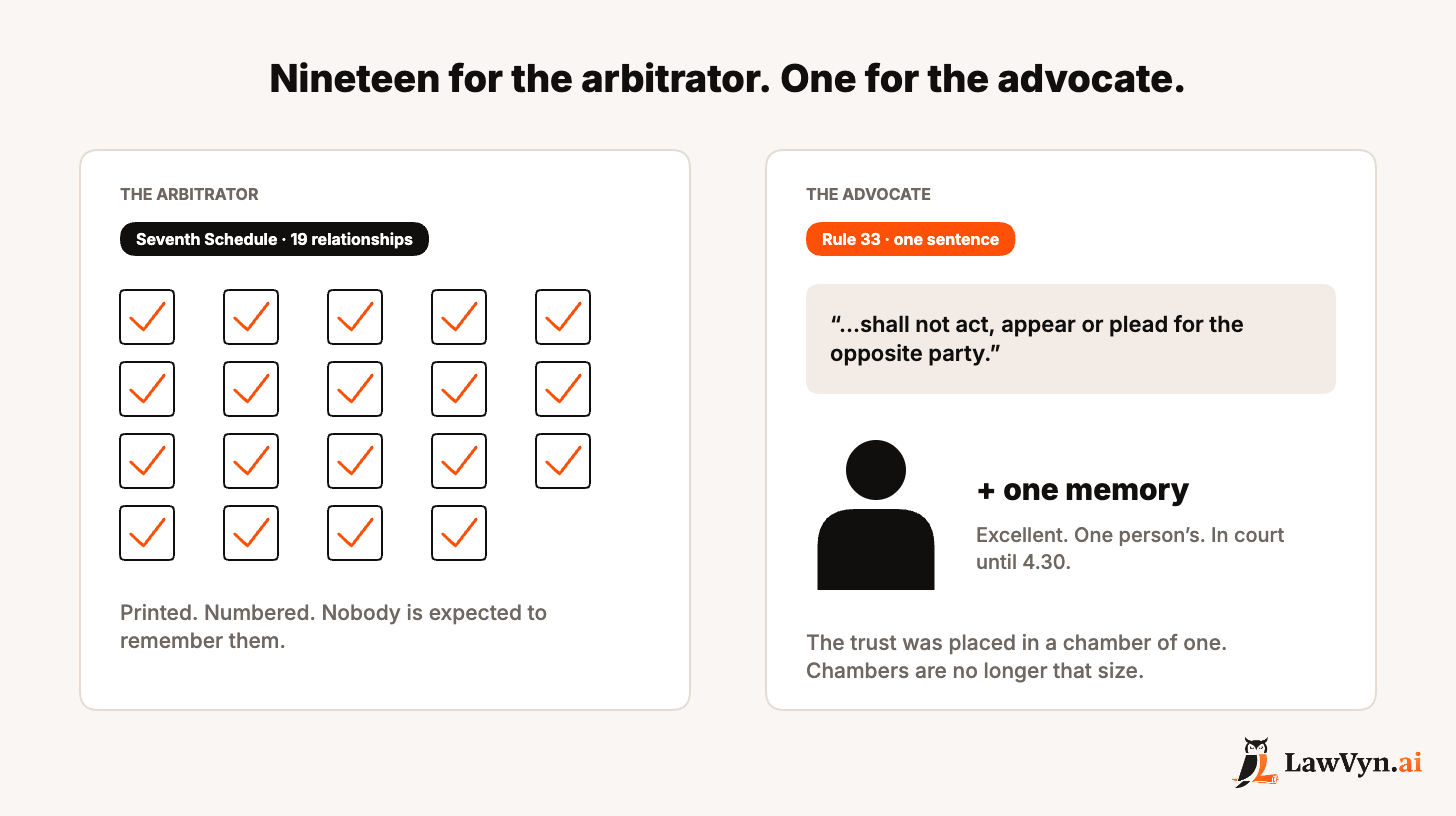
Indian law prints a checklist for arbitrators. The Seventh Schedule of the Arbitration Act lists nineteen relationships that make a person ineligible to sit. Nobody is expected to remember them.
For the advocate the law prints one sentence and trusts the chamber to remember.
That trust was placed in a chamber where one person took every brief and kept every file. Chambers do not look like that now. Five people take briefs. Two associates joined last year. Somewhere in the past decade are a few hundred consultations that never became files.
The memory asked to hold all of this is excellent. It is also one person's, and it is in court until 4.30.
Memory does not scale. Practices do. That gap is the whole problem.
How other bars answered it
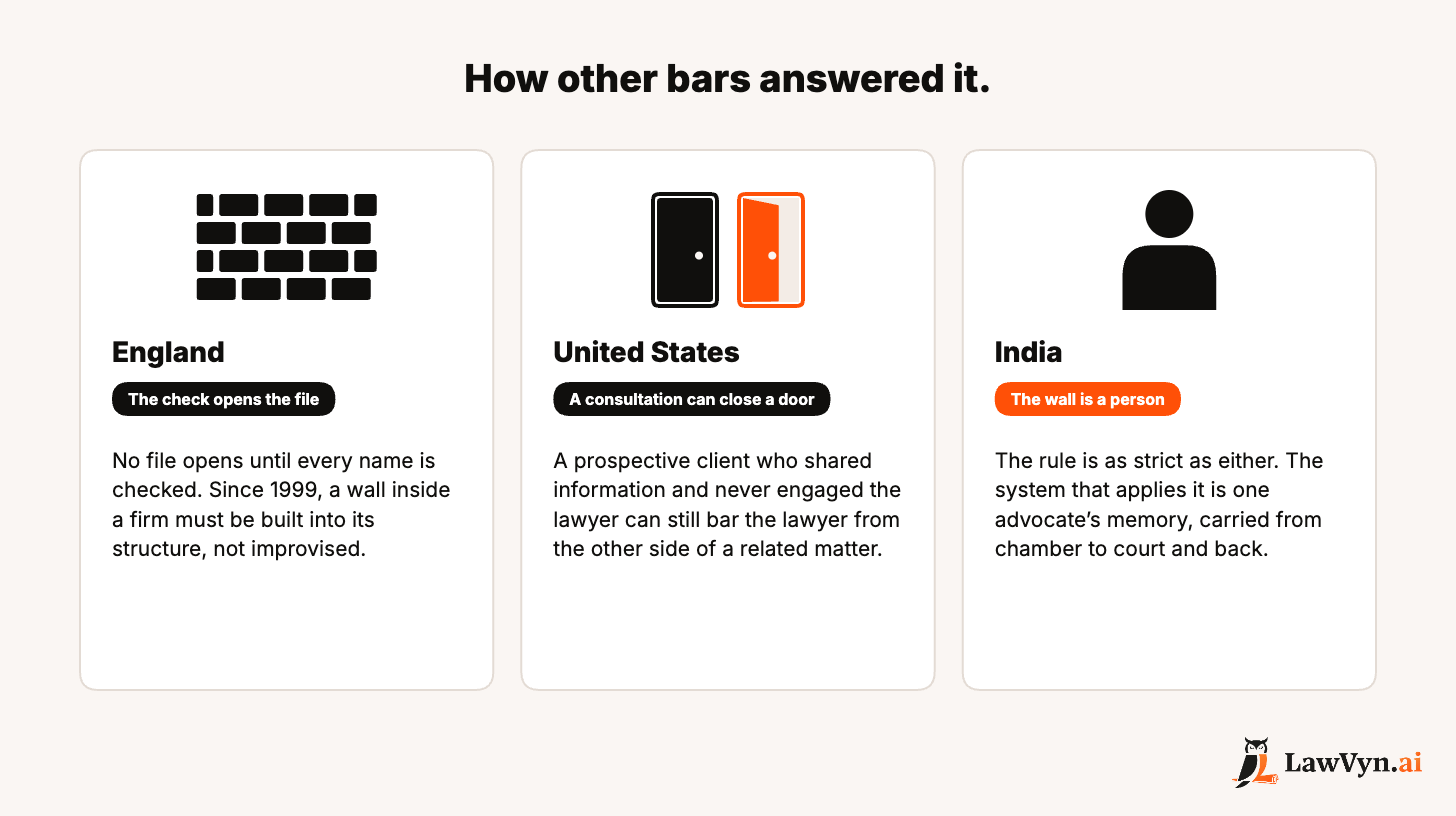
In England no file opens until a conflict check has run against every name the firm has ever acted for or against. The regulator treats acting in a conflict as a breach in itself, so the check is built into opening a file. In 1999 the House of Lords went further: a firm acting against a former client must show there is no real risk of its confidences being used, and any wall inside the firm must be built into its structure before it is needed, not improvised for the occasion.
In most Indian chambers the wall is a person.
In the United States a prospective client who shares information and never engages the lawyer can still bar that lawyer from acting against them in a related matter. American firms record the people they said no to.
The Indian rule is as strict as either. The systems around it are personal.
The cost of finding out late
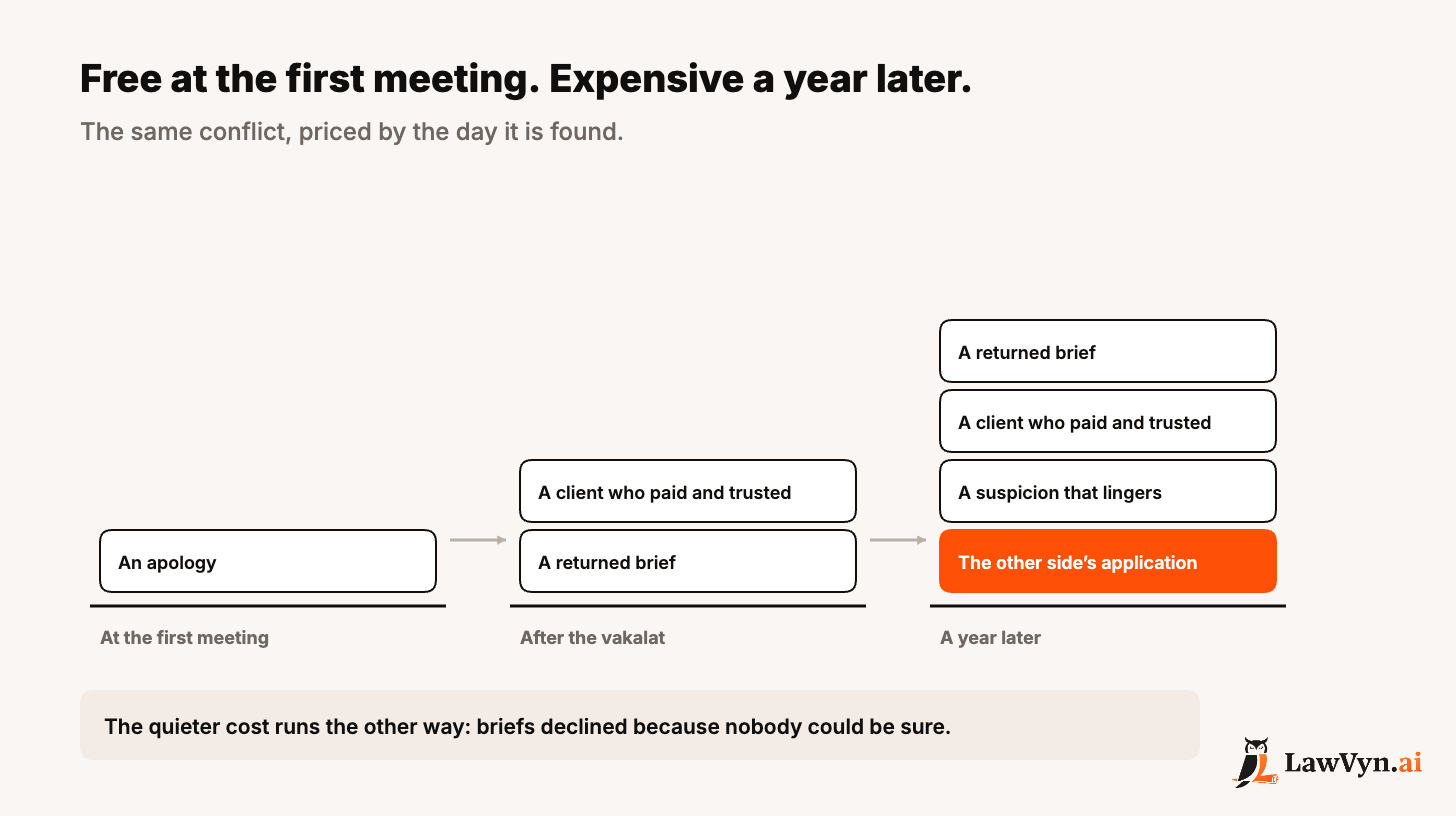
A conflict is the only problem in practice that is free at the moment of saying yes and expensive a year later.
Found at the first meeting, it costs an apology. Found after the vakalat, it costs a returned brief, a client who paid and trusted, the other side's application, and a suspicion that lingers even when nothing was misused.
The quieter cost runs the other way: briefs declined because nobody could be sure. A memory that cannot say yes with confidence says no, and the practice pays for that too.
Neither cost appears in any account book. Both are paid every year.
What a chamber can do about it
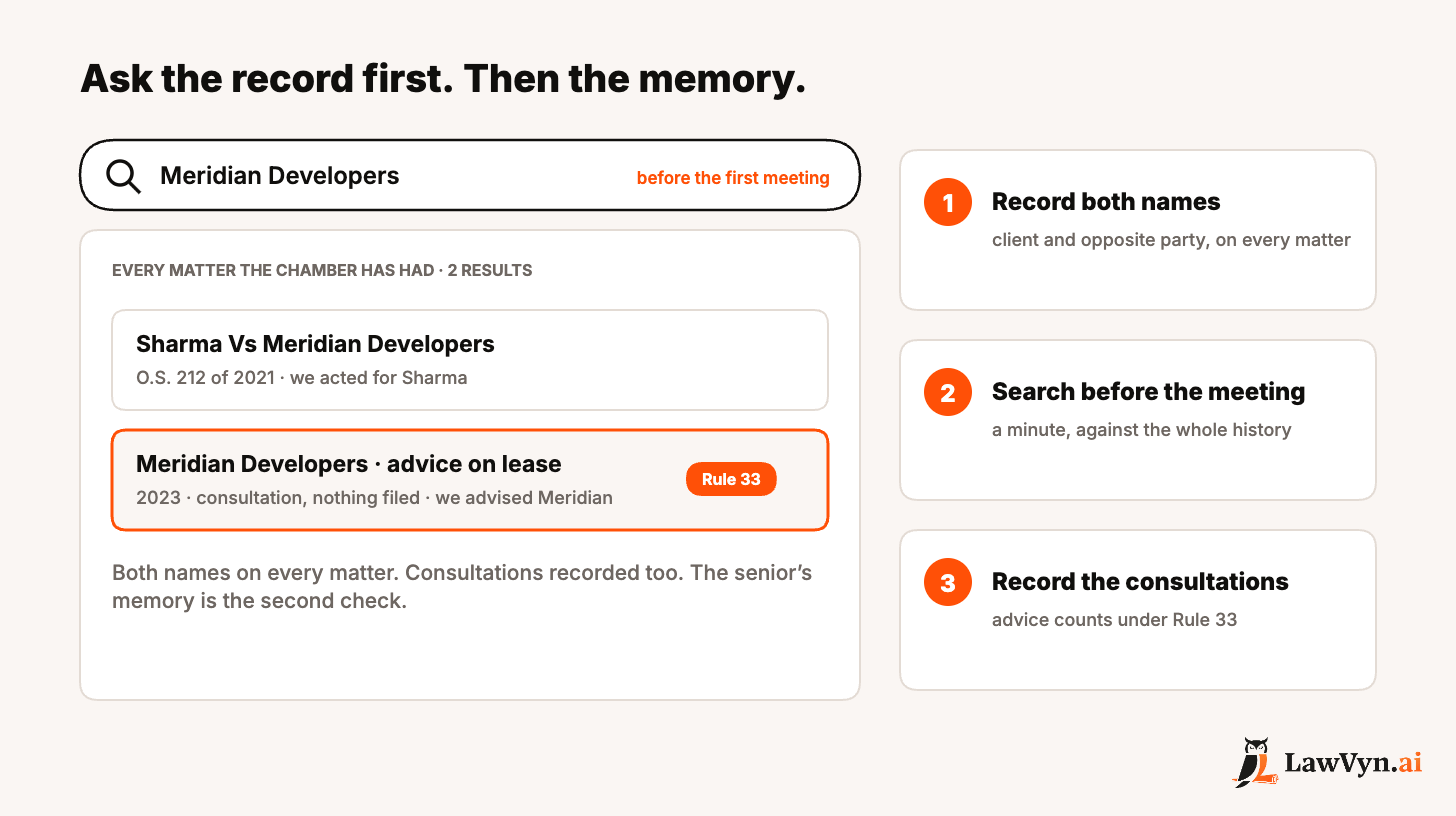
Three moves, in order.
Record both names on every matter, client and opposite party, in the cause title the court uses, so the chamber's history can be searched by anyone in the office, not only recalled by one.
Search before the first meeting, not after. Both names, against every matter the chamber has ever had, before the client sits down. A minute's work. The senior's memory becomes the second check, which is where a good memory belongs.
Record the consultations too. The people the chamber advised and never filed for are the names most easily lost, and Rule 33 counts them like any client.
None of this replaces judgment. Whether a brief is a conflict, and whether consent can cure it, is still the advocate's call. What changes is that the question goes to a record first and to a memory second.
The signature below makes my interest obvious, so I will say it: LawVyn keeps every matter with both names on it, and the chamber's whole history is one search away before a vakalat is signed. When the reference calls, can anyone in the office answer the question, or does it wait for the one person who can?
Before the vakalat
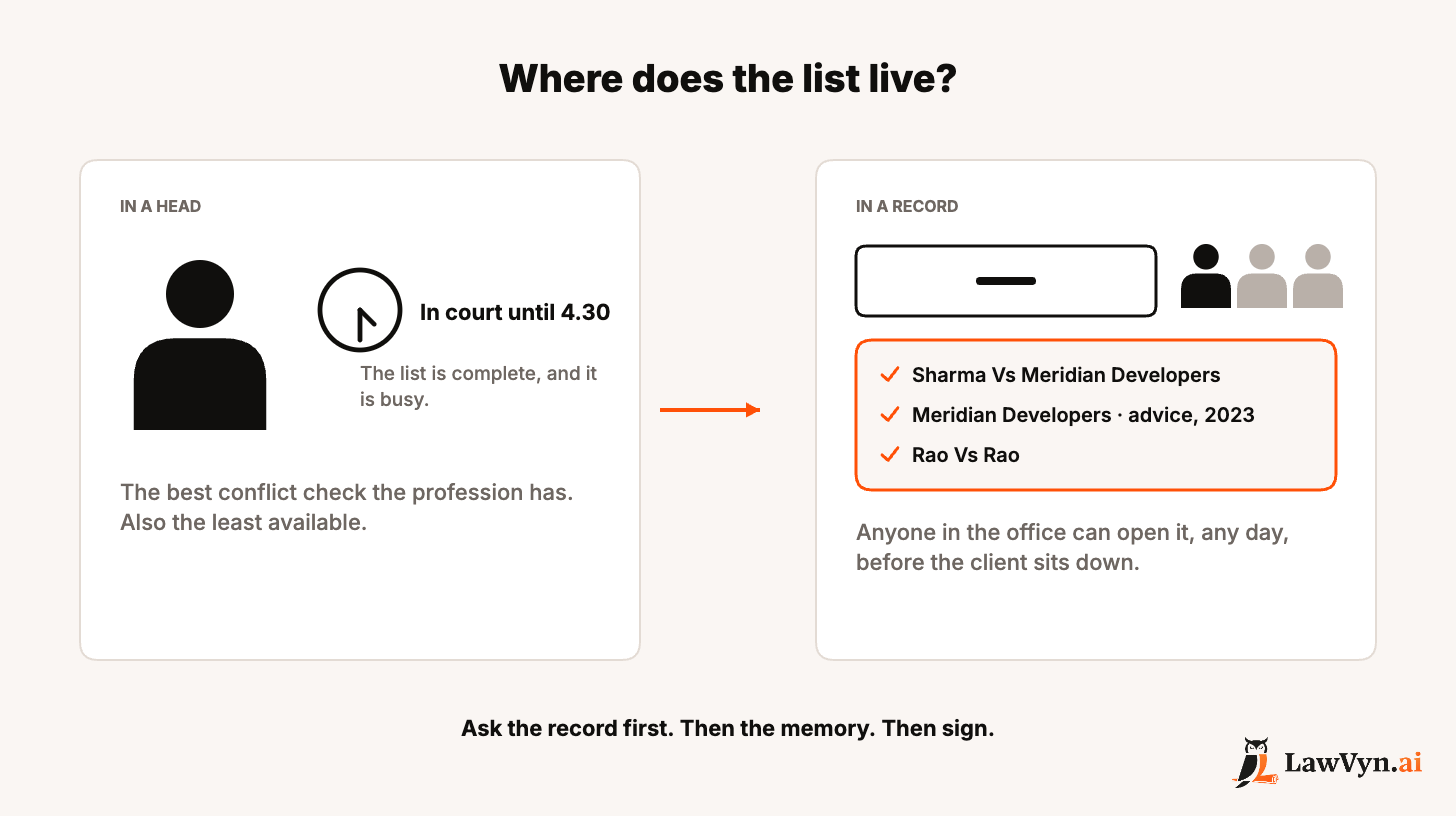
Memory built this profession's reputation for discretion. It was never meant to be its database.
Every chamber has its list. The only choice is whether it lives in a record the office can open, or in a head that is in court until 4.30.
Ask the record first. Then the memory. Then sign.
Ravi Daparthi
CEO of LawVyn
A Practice management software for Indian advocates and law firms.
https://www.ravidaparthi.com/ ·
https://www.linkedin.com/in/ravidaparthi ·
Follow LawVyn on LinkedIn

This essay first appeared on my Substack. New pieces land there first.
Subscribe on Substack
Ravi Daparthi
Entrepreneur, AI product leader, CEO of LawVyn.ai. Co-founder of Signitives and Oorwin.
More from Ravi
Essay
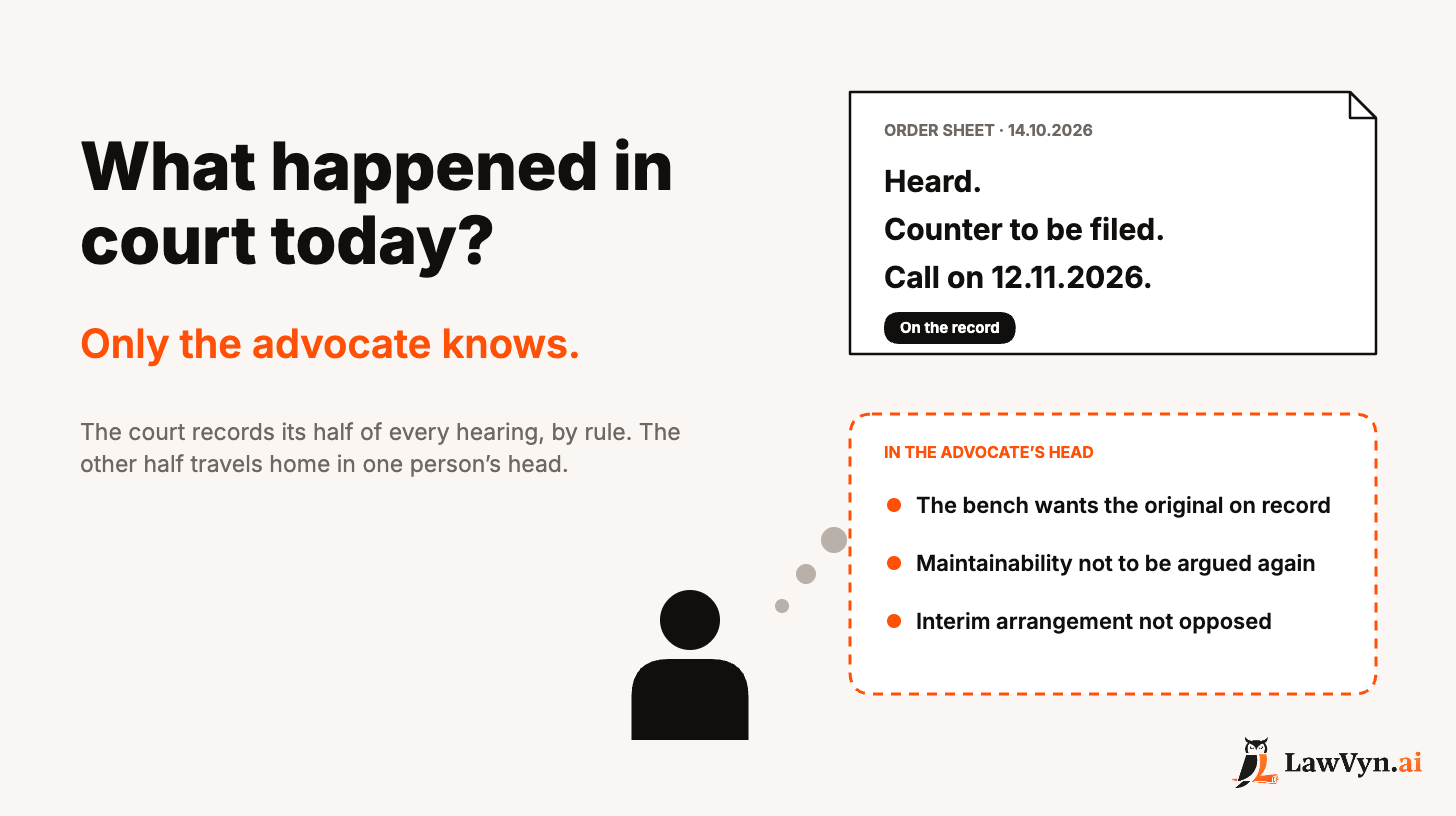
What Happened in Court Today? Only the Advocate Knows.
The court writes down its half of every hearing, by rule. The advocate's half, what the bench said and what comes next, still travels home in one person's head.
14 October 2026 · 5 min read
Essay
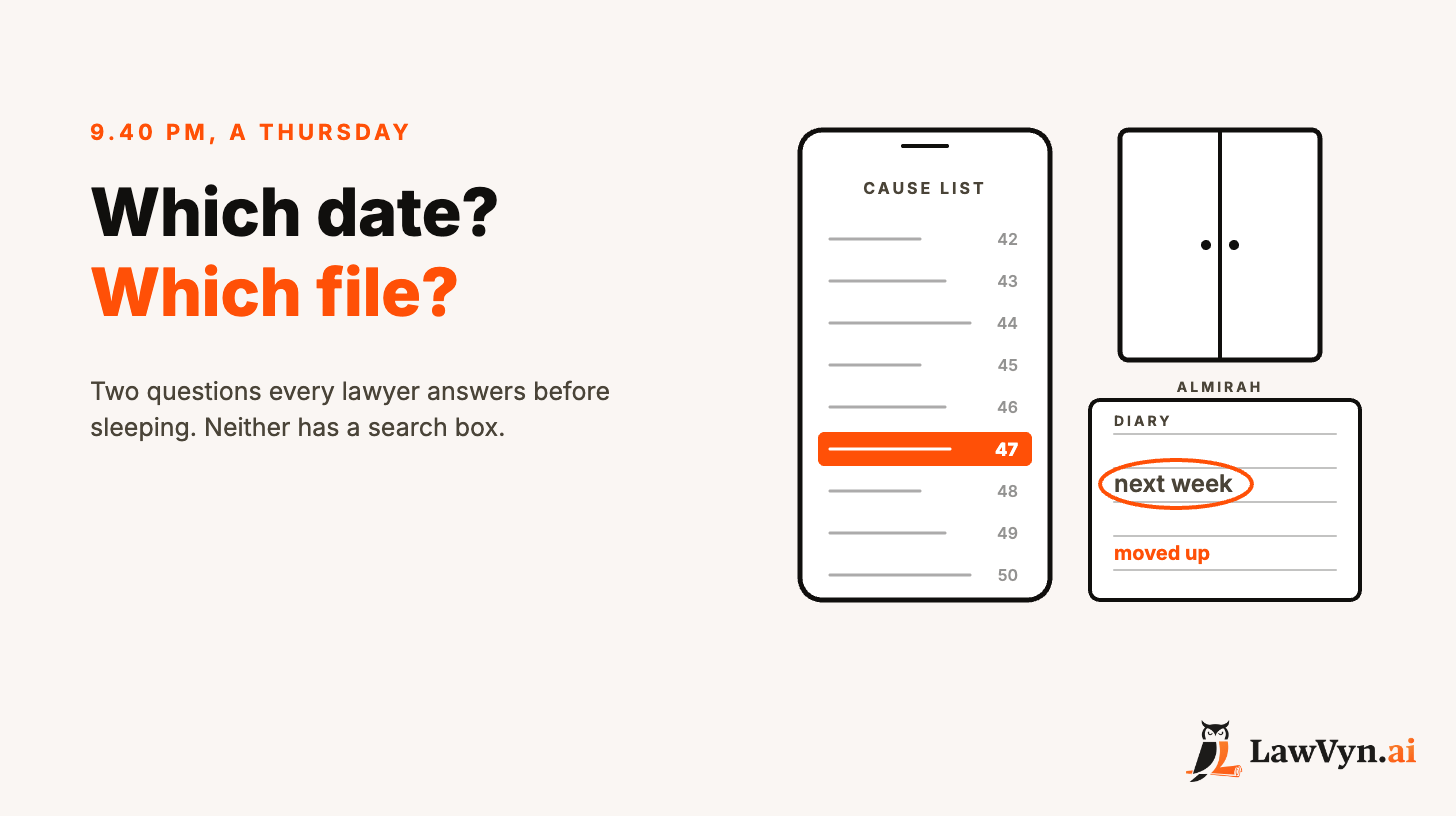
Two Things Every Lawyer Checks Before Sleeping: the Date and the File.
The court moved its calendar and its records online. The advocate’s evening still runs on a paper diary and an almirah. On the two questions that decide tomorrow.
12 October 2026 · 5 min read
Essay
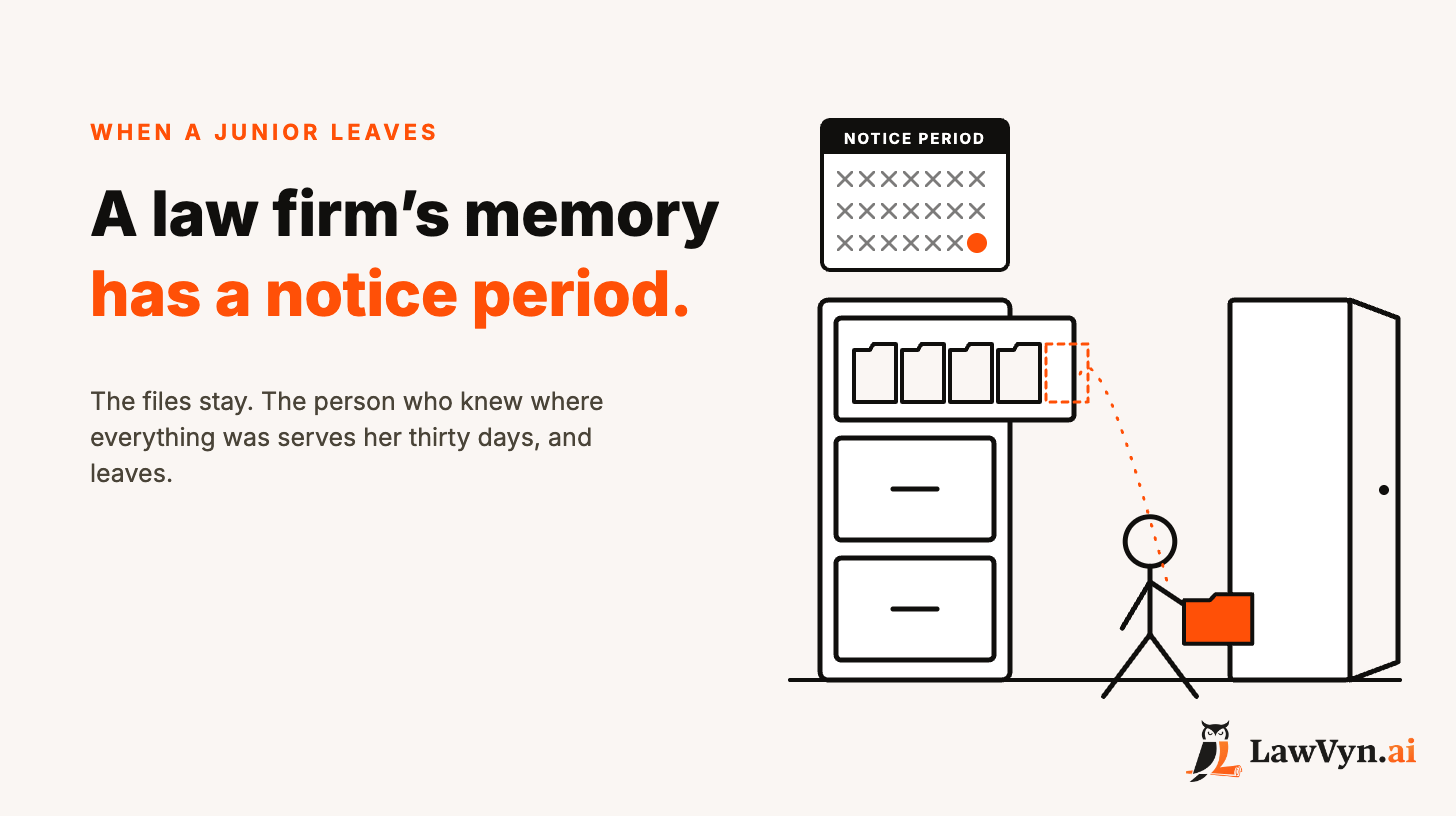
A Law Firm’s Memory Has a Notice Period
Every chamber and law firm owns an asset that never appears on a balance sheet. It lives in people, and people move.
7 October 2026 · 6 min read