Essay · 14 September 2026 · 10 min read
Justice Is Buffering
India’s courts are drowning in cases. Technology is helping in ways most people never see, and it can hurt in ways they don’t expect. A plain-language guide from a founder’s desk.
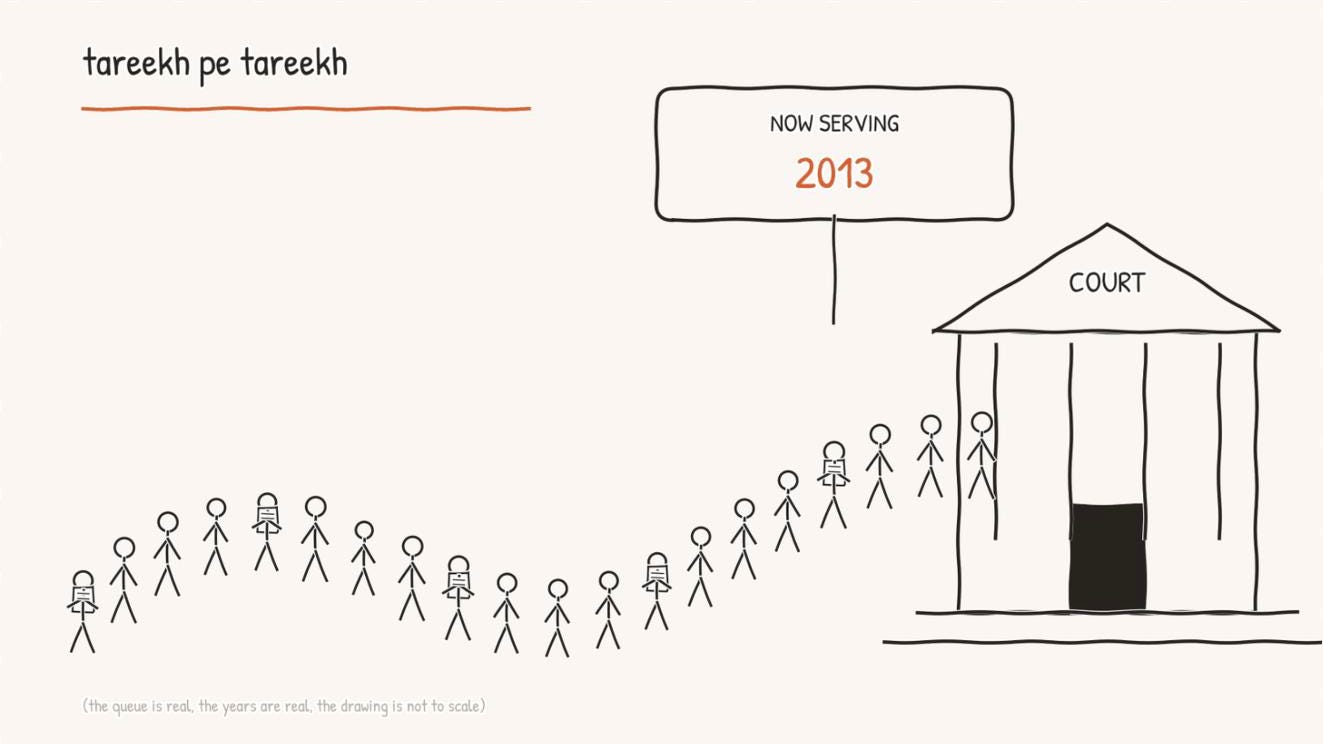
Imagine a man named Suresh. He runs a small hardware shop in a town two hours from Hyderabad. Three years ago a customer paid him with a cheque that bounced. Forty-two thousand rupees. Not life-changing money, but not nothing either.
He did what you are supposed to do. He found a lawyer, filed a case, and waited.
He is still waiting. Every few months he closes the shop for a day, takes a bus to the court, sits on a bench outside a courtroom, and hears the same two words: next date. His lawyer shrugs. The judge has two hundred matters listed that morning. Suresh has become a small expert in a subject he never wanted to learn: how the Indian court system spends time.
I made Suresh up. I did not make up the pattern. Anyone who grew up on Bollywood knows the phrase for it: tareekh pe tareekh. I have seen versions of this pattern more times than I can count, and I suspect you have too.
The queue nobody can see
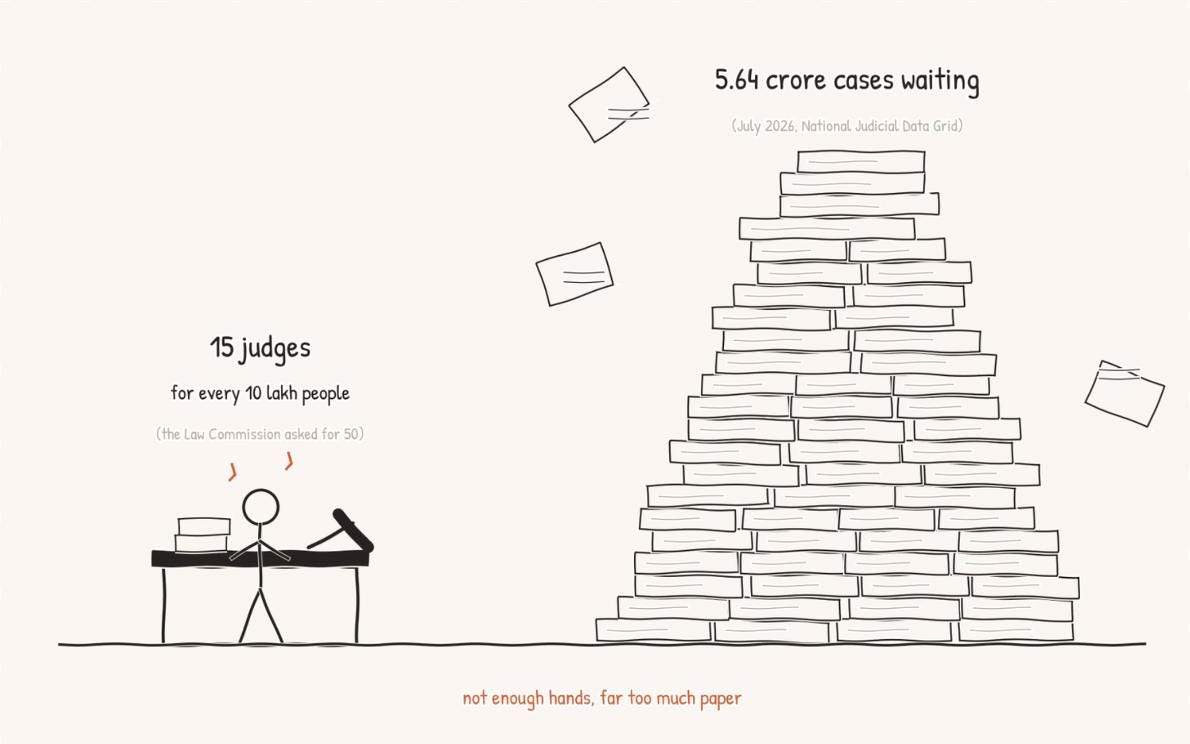
Here is a number I keep coming back to. In July 2026, the Law Minister told Parliament that about 5.64 crore cases were waiting to be decided in Indian courts. That figure comes from the National Judicial Data Grid, which is the government's own live count.
If every pending case were a person, the queue would be longer than the entire population of South Korea.
Some of those cases are older than the people fighting them. The Supreme Court alone has 26 matters that have been pending for more than thirty years. The High Courts together have over 80,000 such cases. Thirty years. A child born on the day of filing could now be a parent, and the matter is still "listed".
Why? The boring answer is the right one. There are not enough judges, and the ones we have are buried.
The India Justice Report 2025 counted about 15 judges for every ten lakh people. The Law Commission recommended 50, decades ago. This July, nearly one in four judge posts in the district courts was vacant, and nearly one in three in the High Courts. So the queue grows faster than anyone can clear it, no matter how hard the people inside the system work. And most of them work very hard.
Now add paper. Physical files, certified copies, summons delivered by hand, a witness who did not turn up, a lawyer who is busy in another courtroom. Each of these costs a date. And in India a date is not a day. It is months.
Suresh does not experience any of this as policy. He experiences it as a bus ticket, a closed shop, and a slow leak of faith in the idea that the system will show up for him.
The parts technology has already fixed, quietly
The reason I write this with some hope is that a lot has changed, and most people have no idea, because it happened without a launch event.
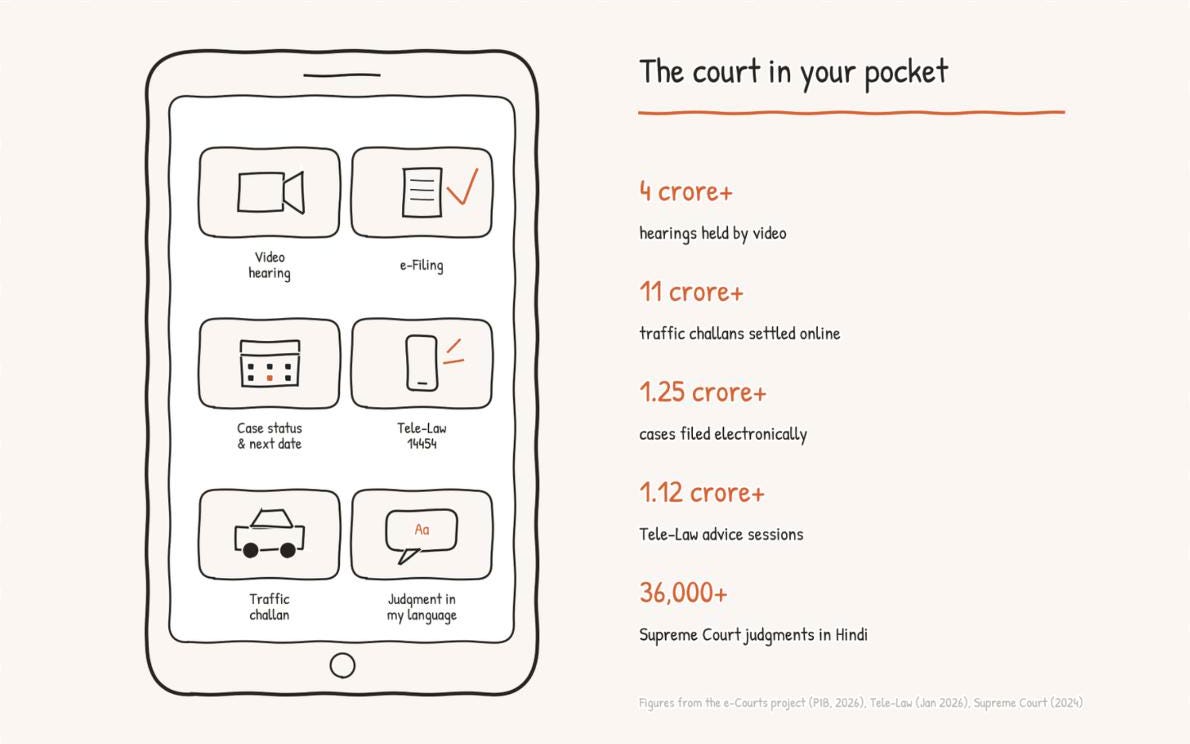
Start with video hearings. Before 2020, the idea of a judge hearing a matter over a screen sounded like science fiction to most lawyers. The pandemic forced the issue. By 2026, Indian courts had held over 4 crore hearings by video conference. For someone like Suresh, that can be the difference between losing a day's income and losing twenty minutes.
Then traffic challans. There are now 31 "virtual courts" that handle traffic fines entirely online, and together they have processed more than 11 crore challans. No visit, no lawyer, no queue. You get a notice on your phone, you pay or you contest. That is one whole category of small cases lifted out of the physical courtroom, and regular judges get that time back.
Filing has moved too. More than 1.25 crore cases have been filed electronically. The courts' own app, which tells you your case status and your next date, has been downloaded close to 4 crore times. Not long ago, knowing your next date meant calling your lawyer's clerk and hoping he picked up.
Language is changing. The Supreme Court has been using AI to translate its judgments into Indian languages. By mid-2024, more than 36,000 of its judgments were available in Hindi and over 17,000 in sixteen other languages. That reads like a statistic until you remember that most Indians have never been able to read what their highest court decided, in a language they actually speak.
Advice is closer. Through the Tele-Law programme, a person can walk into the Common Service Centre in their village, or call a toll-free number, and talk to a lawyer before filing anything. Over 1.12 crore such advice sessions have been given. Many problems die right there, which is exactly where they should die: before they become cases.
And then there are Lok Adalats, the settlement days where parties are helped to reach an agreement instead of fighting a full trial. On 12 September 2026, a single National Lok Adalat settled over 2.10 crore matters in one day, most of them disputes that had not yet reached a courtroom. The data grid was used to find the oldest matters and push them to the front of the line.
None of this is glamorous. None of it is "AI will replace judges". It is plumbing. But plumbing is what cities are made of.
What AI can actually do for someone like Suresh
This is the part everyone wants to talk about, so let me be careful with it.
The pending-case problem is mostly a capacity problem, and AI does not add judges. What it can do is remove the small frictions that eat a judge's day, and put a basic level of understanding in the hands of people who never had it.
Three things I see working.
First, reading. A lot of a lawyer's time goes into finding the one relevant paragraph in a 300-page file. Machines are now very good at this: summarising a bundle, pulling out the dates, flagging what a document says and what it does not. When a lawyer spends less time hunting, they can charge less, or serve more people, or both.
Second, explaining. Ask a plain question in Telugu or Hindi and get a plain answer about what a notice means, what your options are, roughly what it might cost. Nobody should call that legal advice. Call it the thing you needed before you knew whether you needed a lawyer at all. In a country with 15 judges per ten lakh people and about six rupees per person per year spent on legal aid, that first layer of understanding matters more than it sounds.
Third, the boring back office. Drafting the routine notice. Tracking which case is up on which date in which court. Reminding the client. A surprising amount of "delay" has nothing to do with a judge thinking hard. Someone simply forgot.
Full disclosure: I spend my days building software for lawyers and law firms, so I have a stake in this. I also have a front-row seat, and the seat has taught me to worry about a few things.
The part where I ask you to slow down
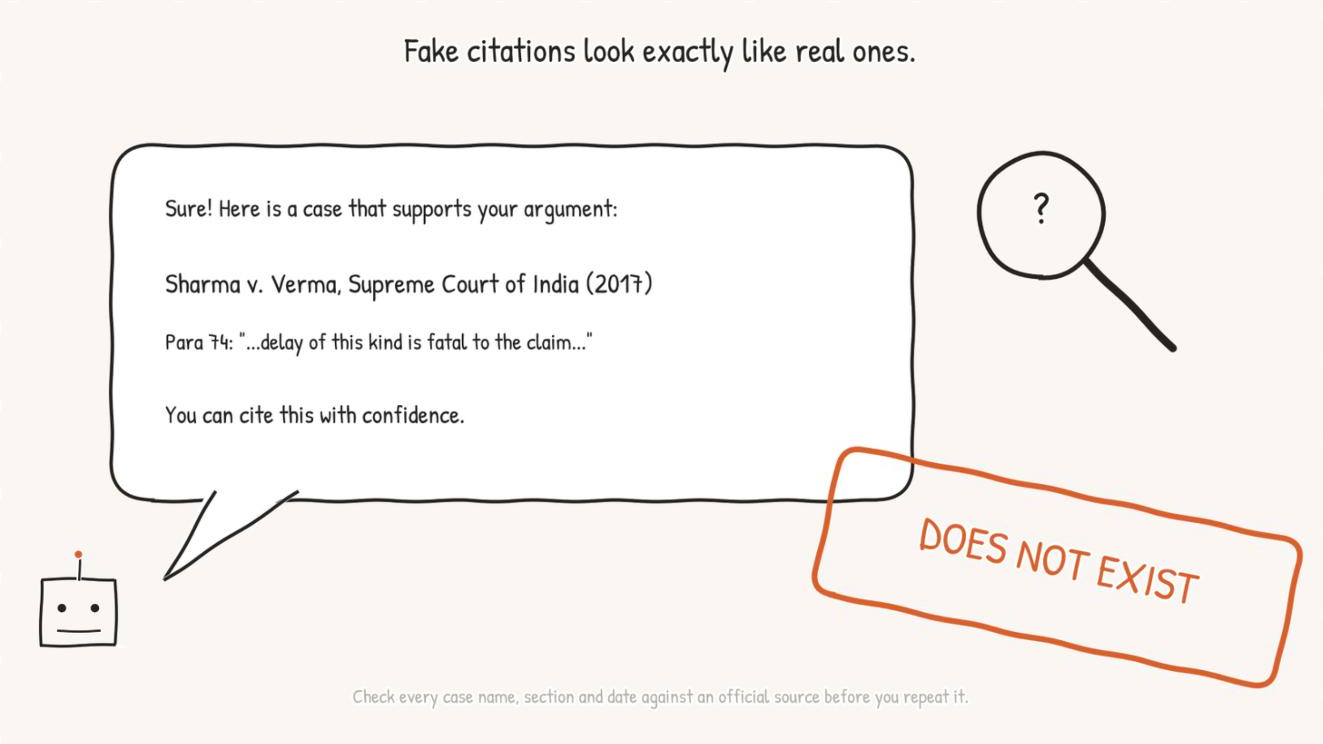
The same technology that reads a 300-page file in seconds will also, with complete confidence, invent a court judgment that never existed.
This is not a hypothetical. In July 2026, the Supreme Court set aside an order of the National Company Law Tribunal, the body that decides company disputes, because the order relied on six earlier judgments, and every one of them was either fake or pointed to paragraphs that did not exist. The judges called citing such judgments without checking "a misconduct on the part of an advocate", compared the spread of fake case law to a poison gas leaking through the legal system, and asked the Bar Council of India to frame guiding principles. They also said something worth writing on a wall: the court will use AI in aid of its work while keeping "a human in the loop at every stage".
India is not alone in this. In 2023, two New York lawyers were fined after filing a brief full of cases that ChatGPT had made up, cases the tool had assured them were real. In 2025, the High Court in London warned lawyers in two separate matters that this could end with them being punished for contempt of court. Earlier this year, the Bombay High Court imposed costs of fifty thousand rupees on a person fighting a case for citing a judgment nobody could find. And the Kerala High Court has told its district judges, in writing, that AI is not to be used to arrive at any finding, order or judgment. Assist, yes. Decide, no.
So here is what I would tell Suresh, and anyone else who is about to type their legal problem into a chatbot.
Treat the answer as a well-read stranger, not a lawyer. It can help you understand and prepare. It cannot represent you, it cannot be held responsible, and it does not know the facts you forgot to mention.
If it gives you a case name, a section number or a date, check it against an official source before you repeat it to anyone. Fake citations look exactly like real ones. That is the whole problem.
Be careful what you upload. Your agreement, your medical report, your FIR copy: once it goes into a free tool, you usually do not control where it goes next. India's new data protection rules were notified in November 2025 and are being phased in, but a law that protects you and a habit of protecting yourself are two different things. Prefer tools that say clearly where your data lives and who can see it.
Watch for the digital gap. Suresh has a smartphone. His father does not. Every time we move a process online, we should ask who just got locked out, and build the counter, the helpline and the help desk alongside the app. District courts now have more than 2,500 e-Sewa Kendras for exactly this. That number should grow faster than the number of apps.
And keep a human in the loop. The Supreme Court said it about judges. It applies to the rest of us. A machine can prepare a decision. A person should make it, and a person should answer for it.
What I actually believe
The Indian legal system is not slow because it lacks technology. It is slow because it has too much work and too few hands, and because it ran for decades on paper and patience.
Technology is the first thing in a long time that has changed the arithmetic. Hearings by video, fines settled online, judgments in your own language, advice in your own village. These are real. They are already here, and they are getting better.
What technology cannot do is care. It cannot decide who is telling the truth, and it cannot carry the weight of getting that wrong. That still belongs to people, and it should.
Suresh does not need a robot judge. He needs his case heard this year instead of next, in a language he understands, without closing his shop for it.
That is a smaller ask than it sounds. And for the first time, it looks like a solvable one.
Sources for the numbers: the Law Minister's written reply in the Rajya Sabha (July 2026) drawing on the National Judicial Data Grid; judge vacancy data placed before Parliament (July 2026); the India Justice Report 2025; e-Courts Phase III figures published by the Press Information Bureau; Tele-Law data as of January 2026; the Supreme Court's translation figures (2024); NALSA's National Lok Adalat figures (12 September 2026); Supreme Court of India, Pooja Ramesh Singh v. Jammu and Kashmir Bank Ltd (2 July 2026); Mata v. Avianca (S.D.N.Y., 2023); Ayinde v. London Borough of Haringey (EWHC, June 2025); the Kerala High Court's policy on AI tools in the district judiciary (July 2025); the Bombay High Court costs order and other Indian instances as compiled by MediaNama (July 2026).
This essay first appeared on my Substack. New pieces land there first.
Subscribe on Substack
Ravi Daparthi
Entrepreneur, AI product leader, CEO of LawVyn.ai. Co-founder of Signitives and Oorwin.
More from Ravi
Essay
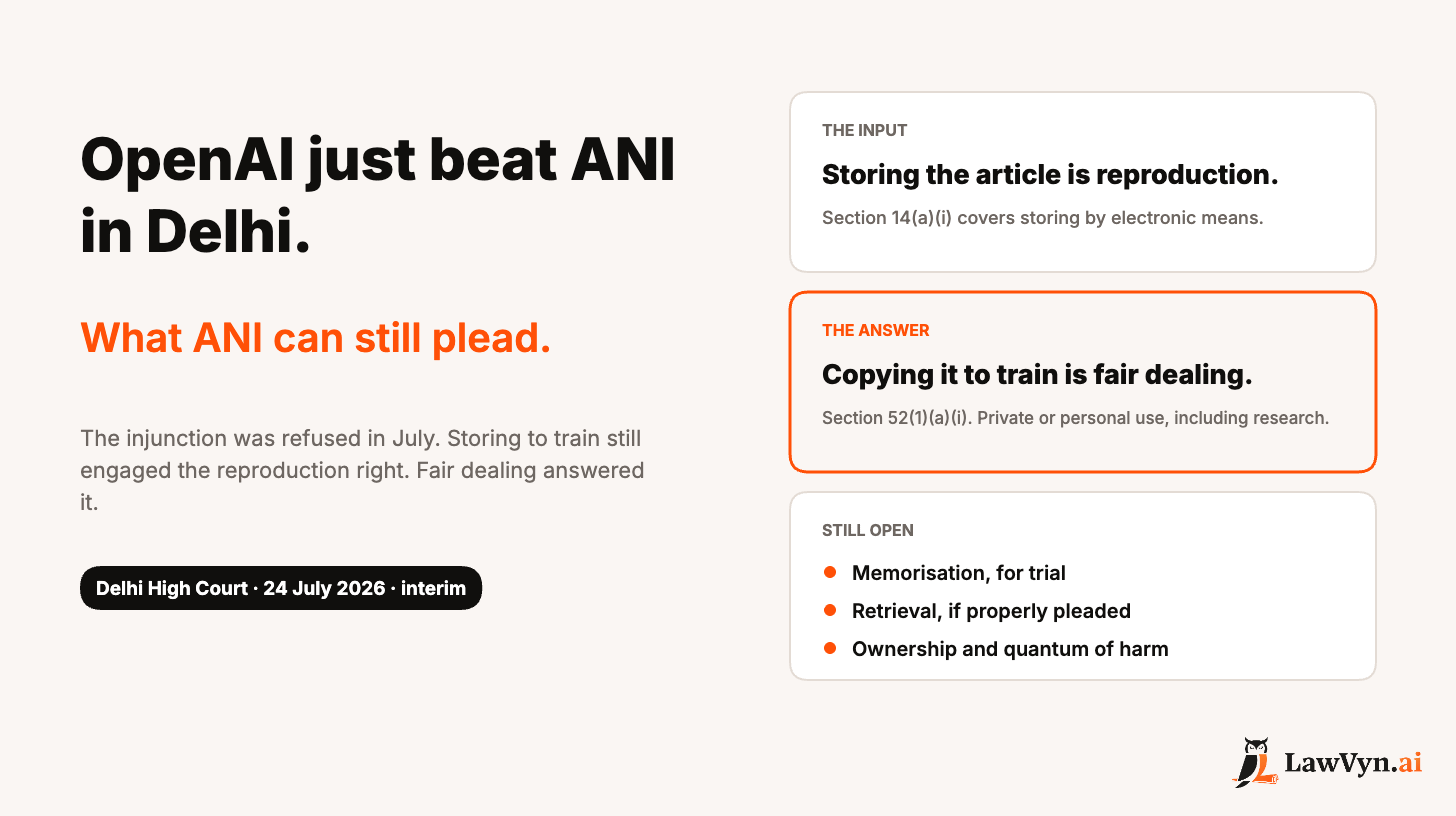
OpenAI (ChatGPT) Just Beat ANI in Delhi. What ANI Can Still Plead.
Interim relief was refused on 24 July 2026. Storing the articles to train still engaged the reproduction right, and fair dealing answered it. The appeal is listed on 8 December.
24 October 2026 · 4 min read
Essay
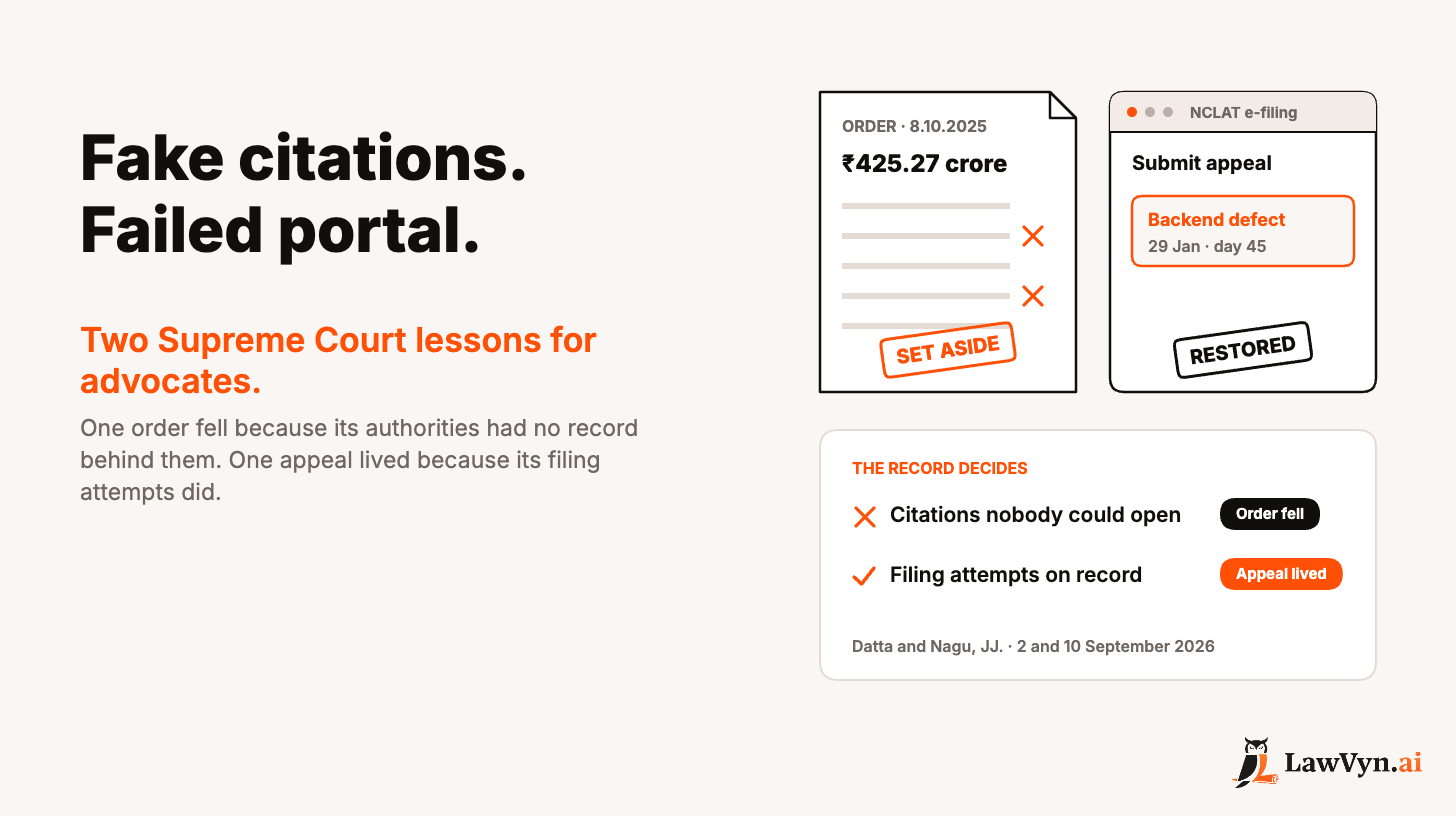
Fake Citations, Failed Portal: Two Supreme Court Lessons for Advocates.
The same bench set aside a 425 crore order built on judgments that did not exist, then restored an appeal filed a day late because the tribunal's portal failed. Read together, they are one rule.
22 October 2026 · 5 min read
Essay
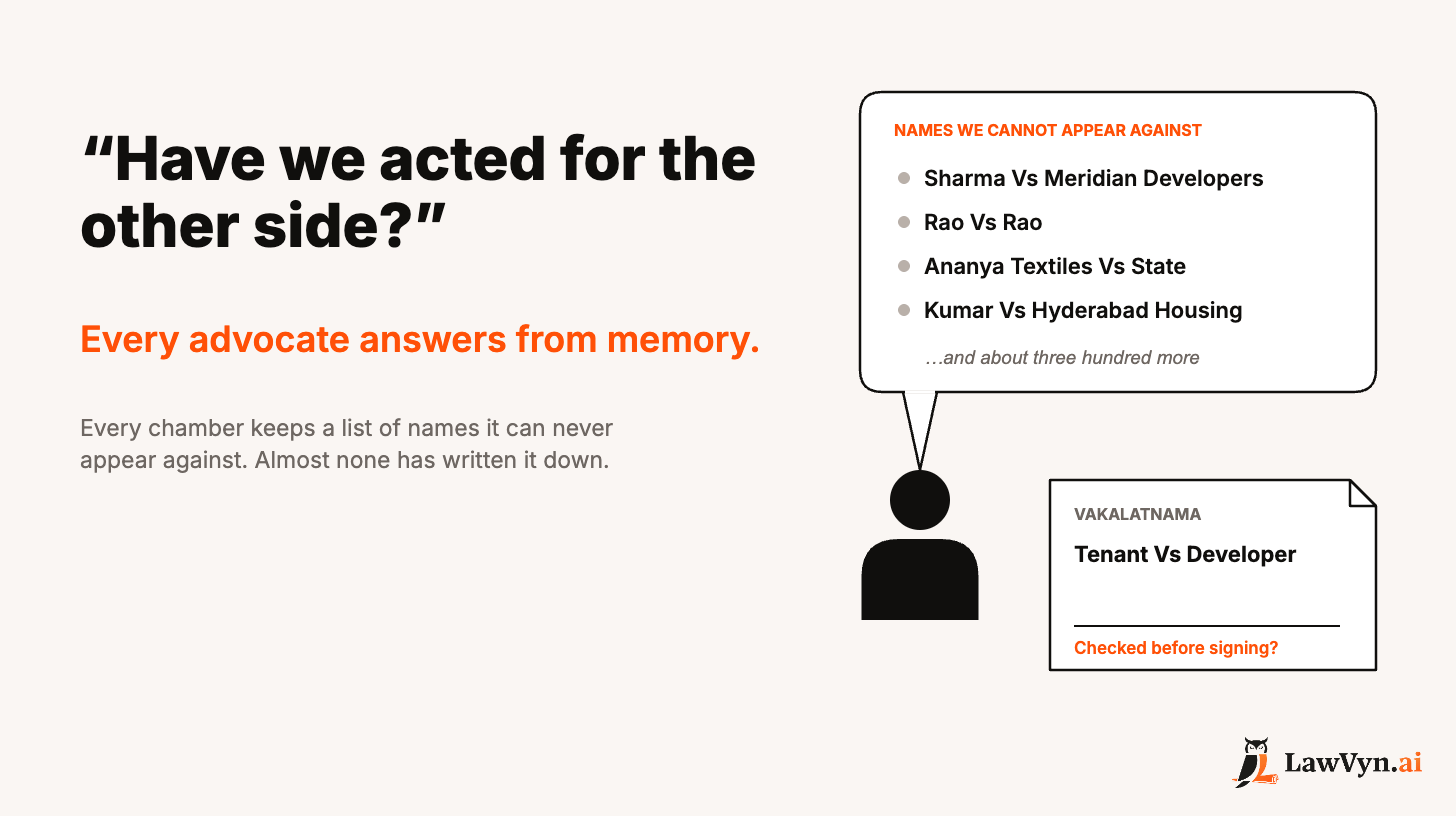
“Have We Acted for the Other Side?” Every Advocate Answers From Memory.
Rule 33, a 1983 suspension and a 2026 Supreme Court judgment say what an advocate owes a former client. The check that enforces it still runs on one person's memory.
20 October 2026 · 5 min read